
Gaudí-style trencadís mosaic for a plunge pool in a country house
A designer asked us to design and make a mosaic for a plunge pool in a private country house, covering not only the walls and floor but the curved pool itself and its bench. We worked in trencadís, the broken-tile style made famous by Antoni Gaudí, using smalti and ceramic tile.
- Area
- 16 m²
- Material
- ArtWorker smalti and ceramic tile supplied by the client
- Technique
- Trencadís; smalti formed on moulds for curves; direct method on flat areas
- Time
- 35 days on site
Trencadís, a style known worldwide
Trencadís is broken mosaic that ignores the classical rules. It is assembled from fragments of ceramic tile and glass of different textures, and its best-known master is Antoni Gaudí.
The designer's brief was to cover the straight surfaces, walls and floor, and also the plunge pool itself and its bench. Our artist developed the sketch and the client approved it. The palette had to stay within the client's colour scheme: light shades with a few bright accents. Smalti and ceramic tile were agreed as suitable materials for an interior mosaic; the client supplied the ceramic tile.
Smalti formed for the curves
For this project our production developed a special way of melting smalti and giving it defined shapes, suitable for cladding the three-dimensional parts of the pool.
First we took impressions on site from every convex surface: the rims, the bowl and the bench. From these we made formers, and smalti that had not yet set was laid on them. As it cooled, the smalti took on the required curve and was then installed on the matching part of the pool. This simplified both assembly and installation.
In all we made more than 80 three-dimensional smalti samples in different shapes and colours for the client to approve. On flat areas the mosaic was laid by the direct method on cement-based tile adhesive and the joints were then filled with epoxy grout. The material was split into tesserae with nippers, a glass cutter and a special smalti hardie.
The most painstaking part of the work was fitting the pieces of smalti and ceramic tile to each other and cutting them to the right module while keeping the joints even and neat.
Why smalti on the curves
Smalti is coloured opaque glass, coloured right through its mass. On convex surfaces, both ceramic tile and smalti form sharp edges during assembly, which could injure people using the pool.
Ceramic tile cannot be ground down, because that would remove the glaze and expose the ceramic body beneath. So wherever skin might touch the pool, on the convex curves, we used smalti and ground every sharp corner to a smooth, safe surface. Smalti keeps its colour and technical properties when ground, so it will serve its purpose for a very long time.
The finished pool
On the finished mosaic the protruding joints were ground smooth and all the joints filled with epoxy grout, which strengthens the structure and keeps moisture from getting between the tesserae.
Project gallery
13 photos — click to enlarge.
Similar projects
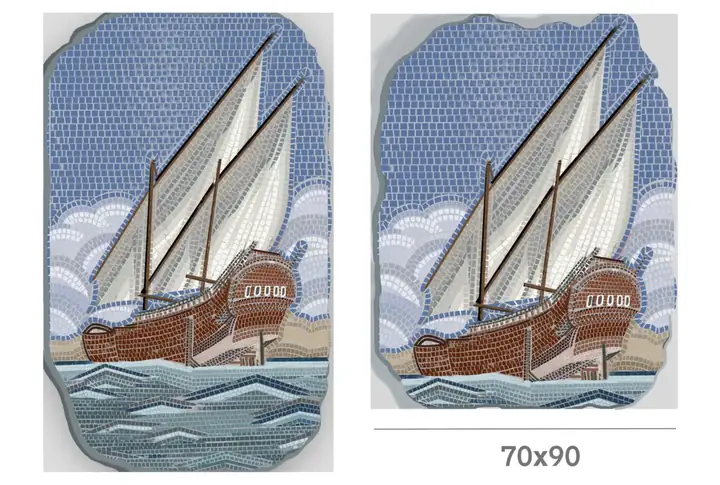
A sea-themed smalti mural for a private client in Muscat, Oman
In winter 2024 a private client in Muscat, Oman, asked us for a sea-themed smalti mural based on a picture they had found online. We developed a sketch for the Roman technique, approved samples and palette within a week, and assembled and delivered the 0.7 m² mural in the shortest possible time.
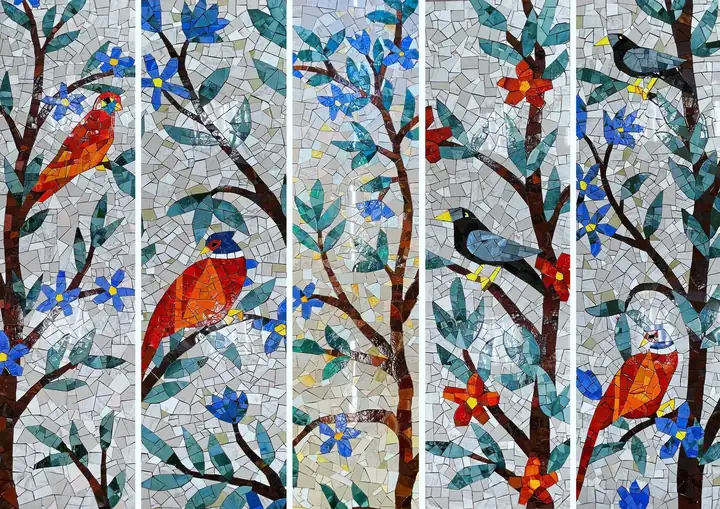
Birds and trees: a series of facade mosaics in smalti and porcelain stoneware
For the facade of a residential building in Kazakhstan we made a series of mosaic panels with birds, trees and flowers: 60 m² in total, with the bright motifs in ArtWorker smalti and the background in porcelain stoneware.
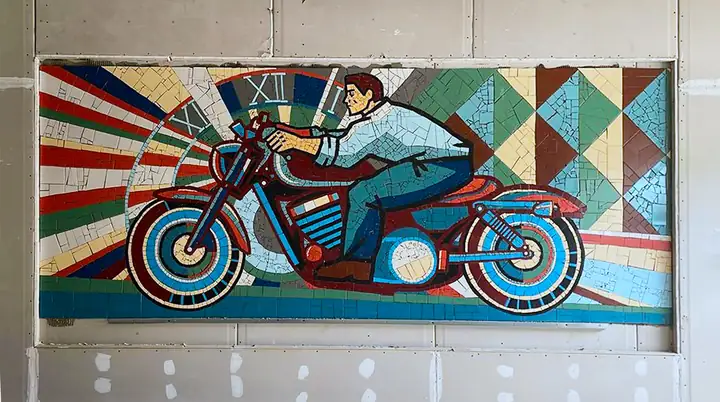
Motorcyclist: a Soviet-style ceramic tile mosaic for a restaurant in Kostanay
A restaurant in Kostanay, Kazakhstan, wanted a mosaic in the manner of a Soviet original. We developed the sketch and assembled a 5 m² ceramic tile mural in just 14 calendar days, then shipped it pre-mounted for installation on site.
Like this project?
We will make a mosaic like this for your space: an artist proposes a sketch, a manager calculates the cost and timeline. The consultation is free.