
Mosaic-style wall painting for a coffee shop in Rostov-on-Don
For one client in Rostov-on-Don we worked on two coffee shops: in the first we assembled a smalti mural, in the second we painted the walls to imitate mosaic. This is the story of the second, a feature wall and a four-sided column finished in about six working days.
- Location
- Rostov-on-Don, Russia
- Material
- Paint, gloss acrylic varnish, glazes
- Technique
- Wall painting imitating mosaic
- Time
- About 6 working days
The idea: a feature wall and a column
The design sits in two places: on the most visible wall of the room, the one you see from the entrance, and on the column in the centre of the space, where the composition is split across each of its faces. The client approved a sketch in which painted tesserae imitate mosaic setting.
A real mosaic gives decades of service, relief and the play of light on the facets of smalti. It is also heavier, more expensive and needs a different schedule. Painting in the style of mosaic solves a different problem: it gives the familiar rhythm of tesserae and joints where a large area has to be covered quickly without loading the structure.
We discuss the difference honestly with the client from the start. Up close, a painting is still a painting: it has no relief and no refraction of light through glass. But from two or three metres, the usual distance in a coffee shop, it reads as mosaic. For areas with direct contact and moisture, such as a bar counter, we still recommend real mosaic.
The column became the second focal point. Each face carries a self-contained fragment, and as you walk around it the image comes together as a whole.
The design sits in two places: on the most visible wall of the room, seen from the entrance, and on the column in the centre of the space, with the composition divided across each of its sides.
Nikita Polyakov, artist at ArtWorker
Preparing the walls and transferring the drawing
For this kind of painting the walls should be as smooth as for ordinary decorating: the imitation joints run in long lines, and any unevenness in the base reads straight away as a distortion of the image.
Once the walls were ready, we printed the sketch at full size and transferred it with artist's charcoal, rubbing the back of the sheets. Charcoal shows well on a light base, is easy to correct and is fully covered by the layers of paint.
We then primed the wall and blocked in each object in a single flat colour. At this stage we deliberately avoided many shades: the aim was to break the composition into large patches of colour and check how they work in the volume of the room. Then we refined the outlines, which became the framework for the whole mosaic-style division.
Shades and joints
In the next layer we added shades so that they resemble mosaic tesserae. The logic is the same as in real mosaic setting: within one patch of colour several close tones appear, and the surface stops being a flat fill. With every layer we kept refining the outlines. Several of the studio's artists worked on the painting at the same time.
The key stage was drawing the joints. We divided the image into pieces so that the pattern looks like mosaic joints, painting them in dark brown, grey and black. A single joint colour across the whole wall would look graphic and flat; changing it to suit the surroundings gives the feel of real setting.
We planned the directions of the setting in advance on a diagram, marking modules over the reference as we would for a real mosaic, in the spirit of andamento. After drawing the joints we corrected the image again to keep it as close to the sketch as possible.
Varnish and glazes
When the paint was dry, we coated the image with gloss acrylic varnish to give the surface the shimmer typical of mosaic. Matt paint reads as paint; gloss reflects light the way smalti does on a wall.
After the first coat of varnish had dried, some areas received glazes: transparent tints thinned with varnish. A glaze does not cover the layer beneath but lets it show through, so the colour becomes complex and deep.
The painting took about six working days in all. In between there was a 14-day break, because the space was under renovation and the floors were being poured. When the schedule is tight, a mosaic mural is often more convenient: it is assembled in the studio in parallel with the renovation and arrives ready.
Up close you can see what the imitation is made of: several close shades inside each module, joints in three colours and a gloss varnish that gives a glassy shimmer.
Nikita Polyakov, artist at ArtWorker
Project gallery
18 photos — click to enlarge.
Similar projects
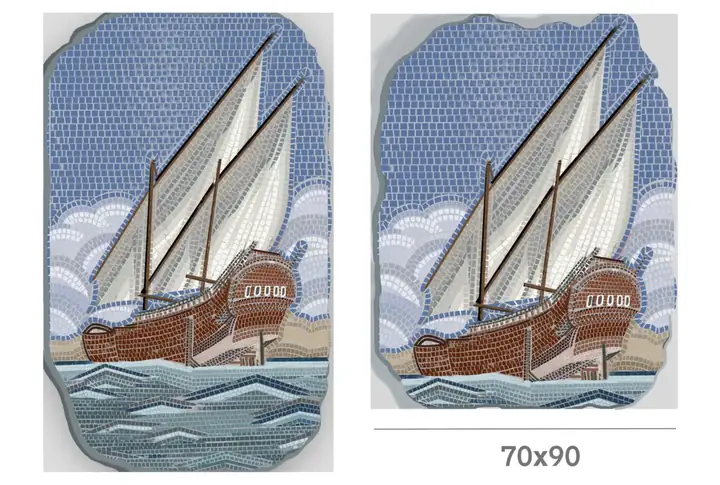
A sea-themed smalti mural for a private client in Muscat, Oman
In winter 2024 a private client in Muscat, Oman, asked us for a sea-themed smalti mural based on a picture they had found online. We developed a sketch for the Roman technique, approved samples and palette within a week, and assembled and delivered the 0.7 m² mural in the shortest possible time.
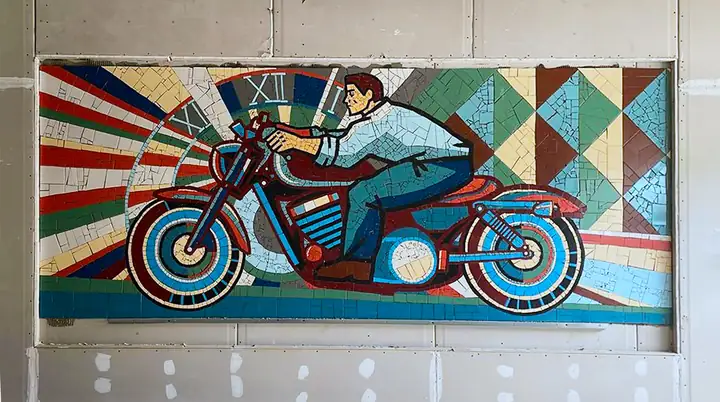
Motorcyclist: a Soviet-style ceramic tile mosaic for a restaurant in Kostanay
A restaurant in Kostanay, Kazakhstan, wanted a mosaic in the manner of a Soviet original. We developed the sketch and assembled a 5 m² ceramic tile mural in just 14 calendar days, then shipped it pre-mounted for installation on site.
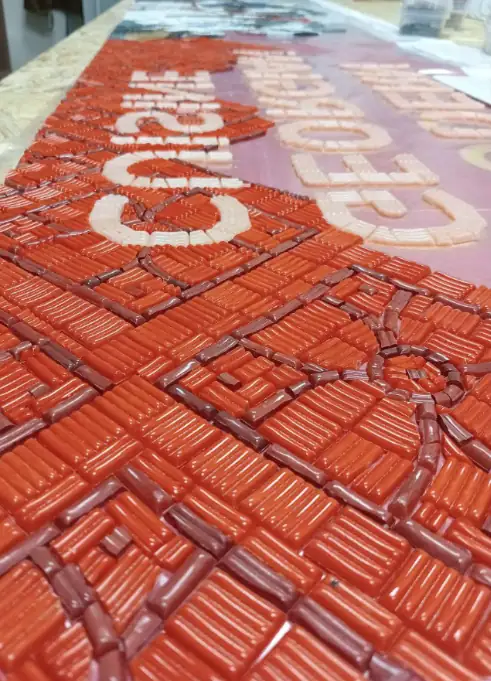
A glass mosaic mural for a Georgian restaurant in Dubai
A client asked us to make a mural for a Georgian restaurant in Dubai as fast as possible. From his sketch of a Georgian wedding set among mountains and stone towers, we made a glass mosaic tile mural in ten days of studio work.
Like this project?
We will make a mosaic like this for your space: an artist proposes a sketch, a manager calculates the cost and timeline. The consultation is free.