
Smalti mural for the Pavlovo embankment viewing platform
The city administration of Pavlovo asked us to make a large mosaic for its new embankment. We assembled it from our own smalti on a 6 × 4 m table and installed it on the curved wall of a viewing platform above the Oka, where tourists and river cruises arrive.
- Location
- Pavlovo, Nizhny Novgorod region, Russia
- Material
- ArtWorker smalti, T07 tiles
- Technique
- Indirect method on mesh, installed on a curved outdoor wall
- Design
- Sketch provided by the client
- Client
- Pavlovo city administration
A landmark for the new embankment
This was not our first project in Pavlovo: a year earlier we decorated a park fence for Victory Day. That work was about memory and history. This time the task was different: to decorate a space that would become a new meeting point for residents and visitors.
Pavlovo is redeveloping its embankment on Lomonosov Street ahead of the city's 460th anniversary, with a cascade fountain, renewed public spaces and new routes for walks and tourism. The mosaic was placed on the wall of the viewing platform, which looks out over the Oka. Tourist groups and river cruises start their visit here before heading to the historic centre and museums.
So the mosaic had to be more than decoration. It had to greet people, tell them about the city at first glance and work as a sign: you are in Pavlovo.
The sketch: symbols of the city
The client provided the sketch. The composition is built on smooth, flowing lines: blue, turquoise and light-blue waves run across the mural and join its left and right halves. They suggest water, the current, wind and the wide river view that people see from the platform.
The most detailed elements are two medallions with a lock and a lemon, the main symbols of Pavlovo. The lock recalls the city's craft past, its metalworkers and their tradition of making beautiful, reliable things. The lemon is a living local legend: people in Pavlovo have long grown lemons at home. Together they show the two sides of the city, a city of craftsmen and a city of living traditions.
Smalti and assembly in the studio
We make our own smalti at our production site in Ulyanovsk. This mural needed smooth, even smalti that could be cut precisely to a set size and module, so we chose our T07 tiles.
We built a 6 × 4 m work table, which let us lay out large parts of the composition and see the image as a whole, not only in fragments.
The waves needed particular care. They had to stay light and fluid so that the mosaic would not look stiff. Every piece of smalti had to follow the direction of the flow: in places the line widens, in places it narrows to a thin strip or merges into the next colour.
The large lettering of the city's name was a challenge of its own. The letters had to be crisp and legible and still fit the rhythm of the whole piece. We watched the outline, inner lines, colour and decorative edging so that the lettering stayed the centre of the composition without fighting the background.
The medallions were the most painstaking part. They are small relative to the whole mural, but they hold the most detail: the shape of the lock, the keyhole, metallic tones, leaves, veins, the lemon itself, volume, light and shade. The background works in large masses of colour; the medallions demand almost jeweller's precision, because every piece changes how the form reads.
Preparing for installation
We planned the cutting scheme in advance. The wall on site is curved, not flat, so the sections had to be small enough to follow the shape of the surface without breaking the image.
Each section was taped, transferred to mesh, labelled, numbered and checked for orientation and position in the overall plan. Then we trimmed excess mesh, wiped off marker lines, checked the edges and packed everything into boxes. Visitors never see this stage, but it decides how quickly and accurately the mural goes up on the wall.
Installation on a curved wall
Installation was as demanding as assembly. On a curved surface nothing can be rushed: each section has to sit exactly in place, without strain, without shifting the lines and without risk to the mosaic already fixed.
We started from the centre and worked outwards. This keeps the geometry of the composition, especially with the large lettering and the date in the middle; an error at the centre only grows towards the edges.
The areas around the steps, 70 of them, were a separate task. They cannot be assembled perfectly in the studio, so part of the work was done on site: fitting, filling in, refining the edges and making sure the mosaic followed the architecture of the wall.
On an outdoor mosaic, grout does more than decorate. It fills the joints between the smalti, protects the base from moisture, keeps dirt and water out and makes the surface whole. The right grout colour also ties the image together: lines soften, colour transitions calm down and the composition reads as one mural. After final cleaning, corrections and checks, the mosaic was complete.
Pavlovo is a city of craftsmen, and it mattered to us that a handmade mosaic should continue that tradition.
Project gallery
36 photos — click to enlarge.
How we can make it for you
Custom smalti murals
We make murals in smalti from our own furnace for interiors, facades, swimming pools and fountains. Sketch, assembly in the studio, packing, shipping and installation by our own team.
From $1,230 per m²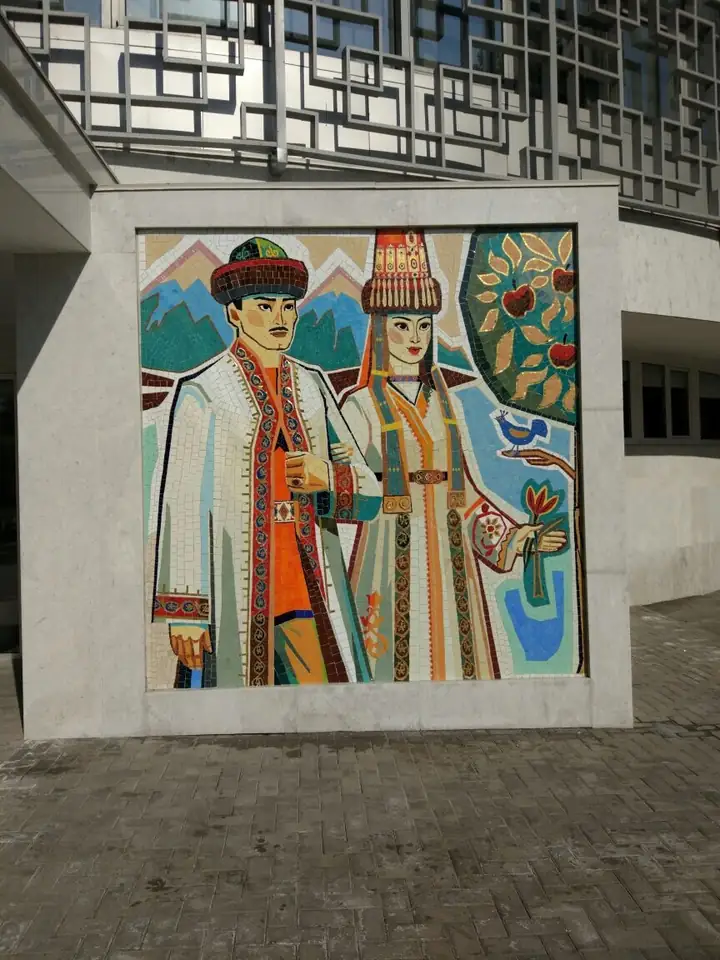
Facade and outdoor mosaic
We make outdoor mosaics in smalti and porcelain stoneware for building facades, fountains, monuments and garden sculpture, from a small niche to a facade of several hundred square metres.
From $860 per m²Similar projects

An 80 m² mosaic for a park fence in Pavlovo
The town administration of Pavlovo, a small historic town on the Oka river, commissioned us to decorate the fence of a park. We designed and made a mural of more than 80 m² on a wartime theme, with a two-metre Order of Victory in classic smalti at its centre.
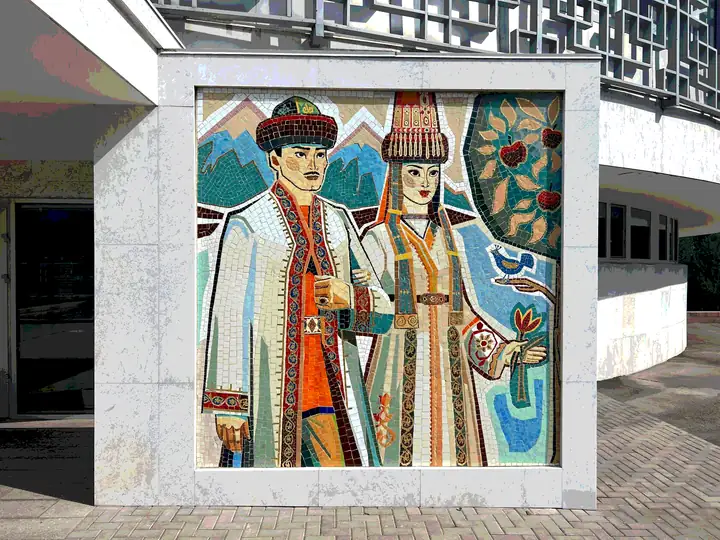
A smalti mural for the Wedding Palace in Almaty
In 2017 we made a 2.7 × 2.7 m smalti mural for the Wedding Palace in Almaty, after a sketch by a local artist. When we visited Almaty in summer 2023 it looked exactly as it did on the day it was installed.
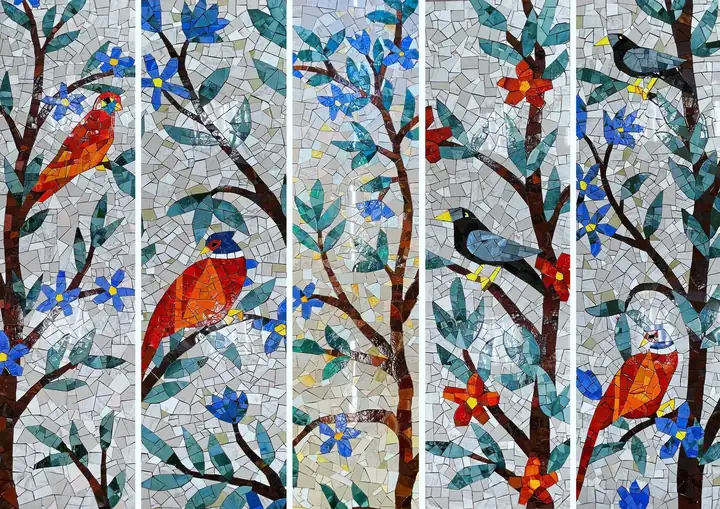
Birds and trees: a series of facade mosaics in smalti and porcelain stoneware
For the facade of a residential building in Kazakhstan we made a series of mosaic panels with birds, trees and flowers: 60 m² in total, with the bright motifs in ArtWorker smalti and the background in porcelain stoneware.
Like this project?
We will make a mosaic like this for your space: an artist proposes a sketch, a manager calculates the cost and timeline. The consultation is free.