
A Soviet-style smalti mural for an IT company office in Moscow
A leading IT company, Sota Lab, asked us for a smalti mural on the theme of new technology, in Soviet style and on a tight deadline. Four artists made it in a month from our own split smalti, and it is now the centrepiece of the company's Moscow office.
- Location
- Moscow, Russia
- Client
- Sota Lab
- Material
- Split ArtWorker smalti
- Technique
- Direct method; double indirect method for faces and hands
- Time
- 1 month
- Design
- Client's sketch, refined by our artists
The client and the brief
Sota Lab brings together programmers and experts in fields from automation and the reliability of industrial equipment to the management and modelling of urban transport systems. Its modern office is a five-minute walk from Ulitsa 1905 Goda metro station.
In October the company commissioned a smalti mural on the development of new technology, in Soviet style. Our artists refined the client's sketch for mosaic. Once it was approved, we prepared our workshop at the production site in the Ulyanovsk region. Large stocks of smalti across the whole palette and a spacious workshop next to production let us move fast.
Two methods in one mural
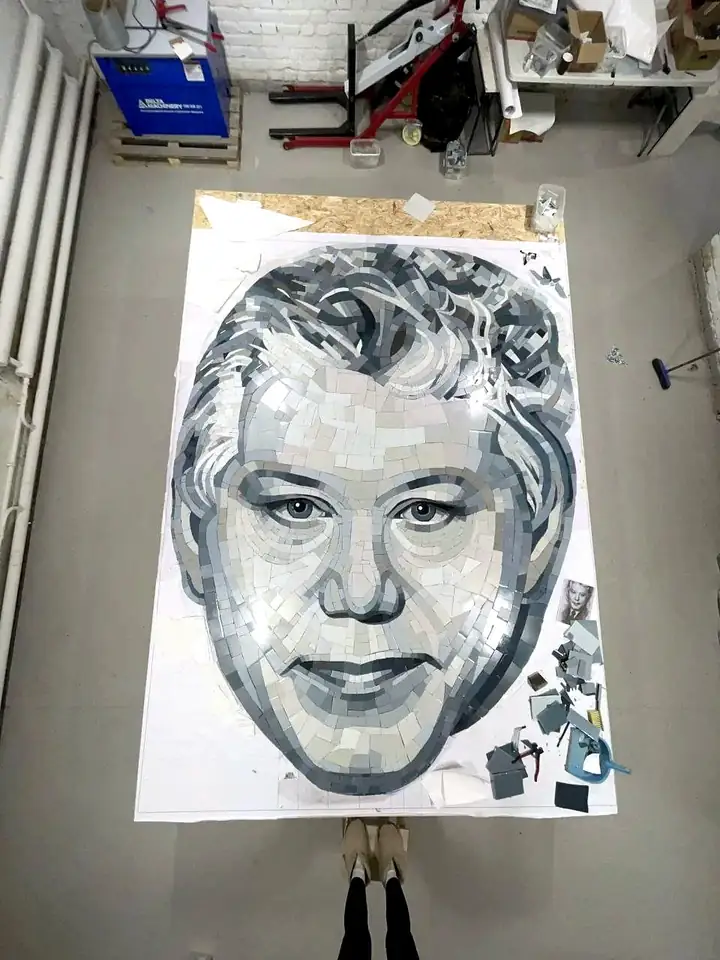
We used two methods, direct and double indirect. Work began with the faces and hands, set by the double indirect method for maximum precision and detail. The image is assembled face up on Oracal adhesive film, so any part can be changed at any moment.
When the faces and hands were done, gauze was applied to the face with an adhesive gelatine solution. The dried section was turned over and the joints filled with fine river sand so the mortar would not come through. Mounting mesh was laid on the back and a cement-based mortar applied (Kerabond T with Isolastic). After 48 hours of curing the work was turned face up, the gauze removed and the gelatine washed off with a damp sponge, ready for final mounting.
Why Soviet monumental art
Interest in Soviet monumental art is growing again. In the early Soviet years monuments were built, but mosaic was hardly used. The first Soviet mosaics, the coats of arms of the RSFSR and the Ukrainian SSR, were laid by hereditary mosaicist Vladimir Frolov in 1925 on the facade of Kievsky railway station in Moscow; in 1930 he also worked on the mosaics of the Lenin Mausoleum. After that, mosaic stopped being associated only with churches and was widely used in metro stations, palaces of culture, theatres and stadiums.
The main themes were the working person, labour, sport, science and the pursuit of knowledge. Scientists were shown with punched tape, computers, flasks, formulas and microscopes. Most of the values this art celebrated are universal, which is why the style still speaks to a technology company today. Our historical notes draw on the book Monumental Art of the USSR by Arseny Kotov (AST, 2023).
A human life is not eternal, but science and knowledge cross the thresholds of centuries.
Igor Kurchatov
Installation in the office
For transport the mural was cut into several sections and packed in a sturdy wooden case. Our craftsmen primed the wall for better adhesion and mounted the sections one by one on cement-based adhesive (Kerabond T with Isolastic). When the mortar had fully dried, a mosaic artist filled in the joints between sections. The Soviet-style smalti mural is now the centrepiece of the office interior.
Project gallery
29 photos — click to enlarge.
How we can make it for you
Custom smalti murals
We make murals in smalti from our own furnace for interiors, facades, swimming pools and fountains. Sketch, assembly in the studio, packing, shipping and installation by our own team.
From $1,230 per m²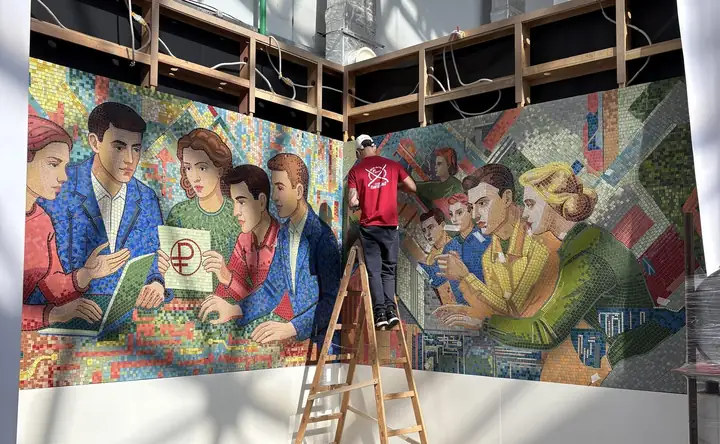
Custom mosaic murals
We make mosaics in our own smalti, natural stone and glass mosaic tile, from a bathroom mural to building facades, church icons and monumental works. Sketch, production, shipping and installation, turnkey.
From $860 per m²Similar projects
A sea-themed smalti mural for a private client in Muscat, Oman
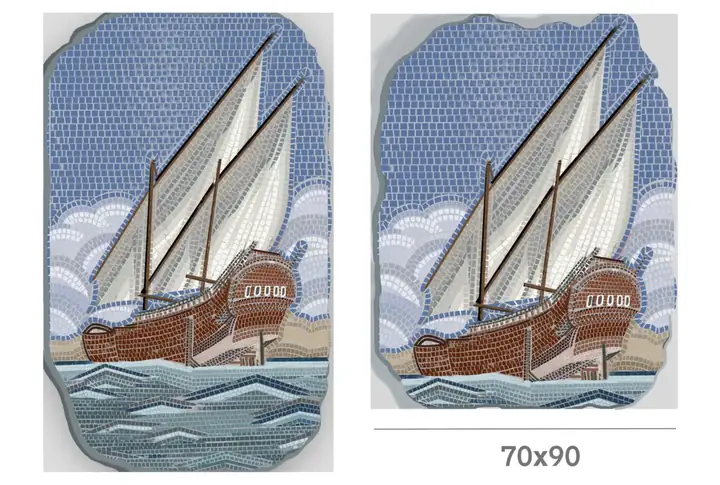
In winter 2024 a private client in Muscat, Oman, asked us for a sea-themed smalti mural based on a picture they had found online. We developed a sketch for the Roman technique, approved samples and palette within a week, and assembled and delivered the 0.7 m² mural in the shortest possible time.
A smalti mural for a modern bathroom: a copy of a Soviet mosaic fragment
For an apartment bathroom we made a 2 m² mural in ArtWorker smalti: a copy of a fragment of a Soviet mosaic, in a restrained palette that sits naturally in a modern interior. From smalti production to finished panel took 14 days.
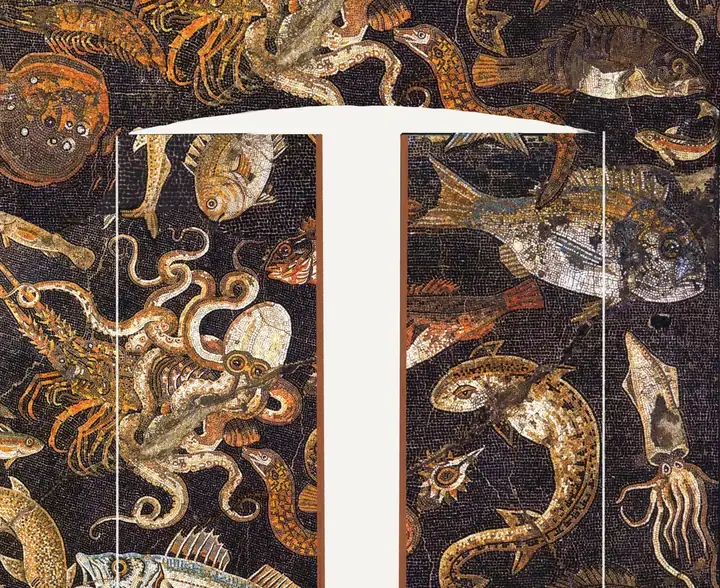
A classical Roman mosaic for a bar in central Moscow
A private client opening a bar in central Moscow wanted part of its walls covered in mosaic in the Roman technique, based on classical Roman subjects. We had 60 days before the opening to make and install almost 13 m² of natural stone and smalti.
Like this project?
We will make a mosaic like this for your space: an artist proposes a sketch, a manager calculates the cost and timeline. The consultation is free.