
Smalti mosaic icon of St Nicholas for a church facade in Shymkent, Kazakhstan
A client sent us a sketch of an icon of St Nicholas the Wonderworker and asked for it in mosaic, on time and with gold smalti on the halo. We assembled it by the direct method on a wall of our studio, cut it into sections, shipped it to Kazakhstan and installed it on the facade of a church in Shymkent.
- Location
- Shymkent, Kazakhstan
- Material
- ArtWorker smalti; gold leaf smalti on the halo and details
- Technique
- Direct method on mesh, assembled on the studio wall
- Design
- Sketch supplied by the client
The brief: an icon from the client's sketch
The client contacted our mosaic studio with a sketch of the future icon: St Nicholas standing at full height with the Gospel in his hand, flanked by medallions of the Saviour and the Mother of God. Our task was to turn this image into a mosaic within the agreed deadline.
The client had one firm request: the halo and certain details of the image had to be laid in gold smalti. The rest of the icon is made of coloured ArtWorker smalti from our own production, made in advance and split to the required module. The artists work with ready-made tesserae and trim them as they go to fit the details of the drawing.
This was not our first mosaic to travel to Kazakhstan: we had earlier made a mural for the Wedding Palace in Almaty. This time the work was destined for the facade of a church in Shymkent.
Direct method on the studio wall
The icon was assembled by the direct method on mesh, on a prepared surface on the studio wall. First a sheet of OSB of the right size was fixed to the wall. The sketch was attached to it, installation mesh was laid over the sketch, and then the adhesive layer and the smalti itself were applied.
This is the opposite of the indirect (reverse) method we used, for example, on our Elephant mural, where the material is laid face down. With the direct method the artist sees the face of the icon all the time, exactly as the viewer will. For an image in which everything depends on the face and the gaze, this matters a great deal.
The image grew from top to bottom, with the background and the figure progressing side by side.
Two artists worked on the icon: one handled the background, the vestments and the ornaments, while the other assembled the face and hands of St Nicholas.
ArtWorker Mosaic Studio
Two artists, two layers of work
The work was clearly divided. The first artist took the background, vestments and ornaments: the large masses of colour and the rhythm of the andamento. The second assembled the face and hands of St Nicholas, the most demanding areas, where every tessera affects the expression of the image.
Gold smalti was used for the halo, the Gospel and elements of the vestments with their crosses.
The most critical part was preparing the mosaic for shipping: the finished icon had to be carefully cut into sections, separated from its base on the wall and packed into wooden crates.
ArtWorker Mosaic Studio
Shipping to Shymkent and installation on the facade
Once cut and packed, the sections were loaded for transport and sent to Kazakhstan. How carefully this stage is done decides the condition in which a mosaic arrives on site.
When the icon was delivered, our specialists travelled to Shymkent and carried out all the work of installing it in a niche on the church facade. Smalti is a classic material for exterior sacred images: it does not fade and withstands the weather for decades.
The client was delighted with the result, and we were glad to take this commission all the way through, from a sketch on the studio wall to an icon in the niche of a church facade.
Project gallery
14 photos — click to enlarge.
Similar projects
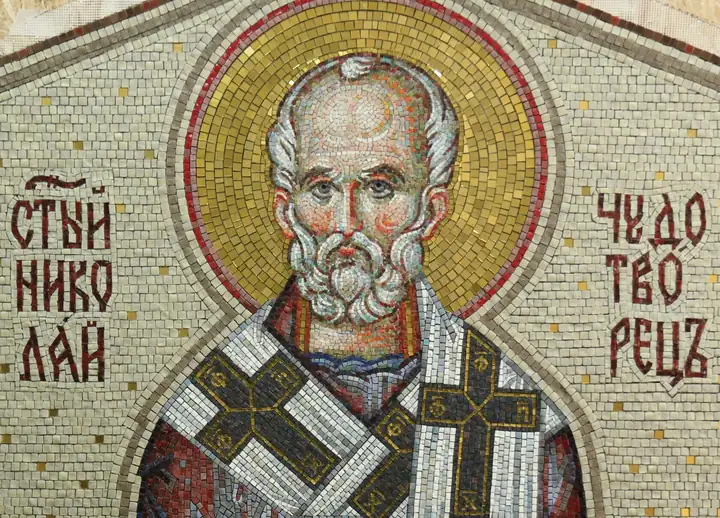
Mosaic icon of St Nicholas for a church facade in Ulyanovsk
We made a smalti mosaic icon for the facade of the Church of St Nicholas in Ulyanovsk. It depicts the Miracle of Nicaea and was assembled in our Moscow studio, then installed over the main entrance by crane in about five hours.
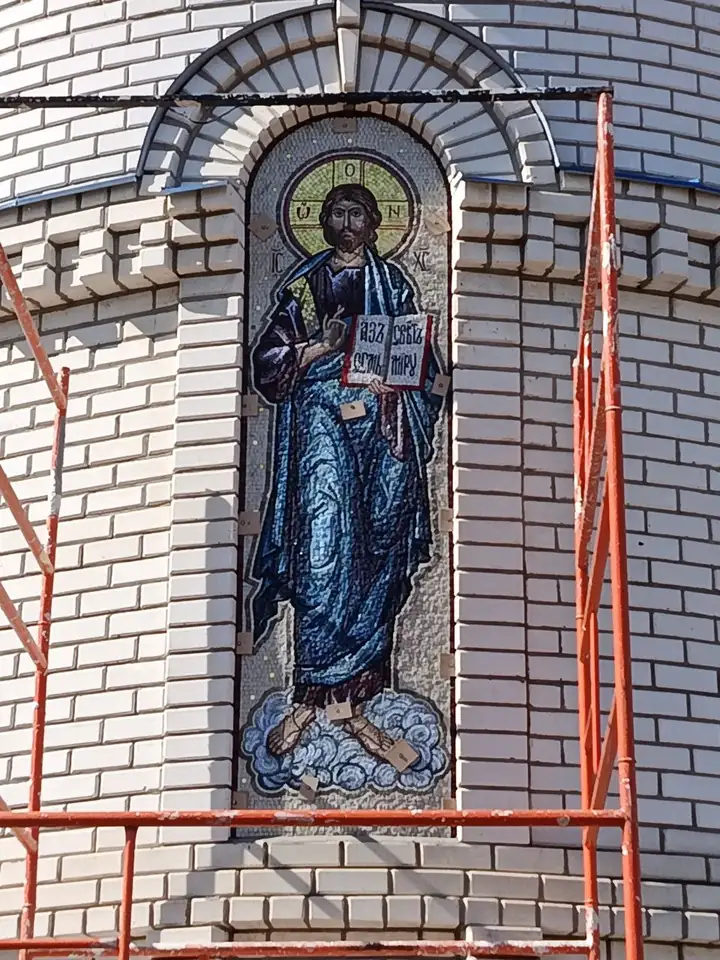
Mosaic icon of Christ the Saviour for the Church of St Nicholas, Ulyanovsk
Our third mosaic icon for the Church of St Nicholas in Ulyanovsk: a full-length Christ the Saviour in our own smalti, designed to match the icons of St Nicholas and St John Climacus we made for the same church.
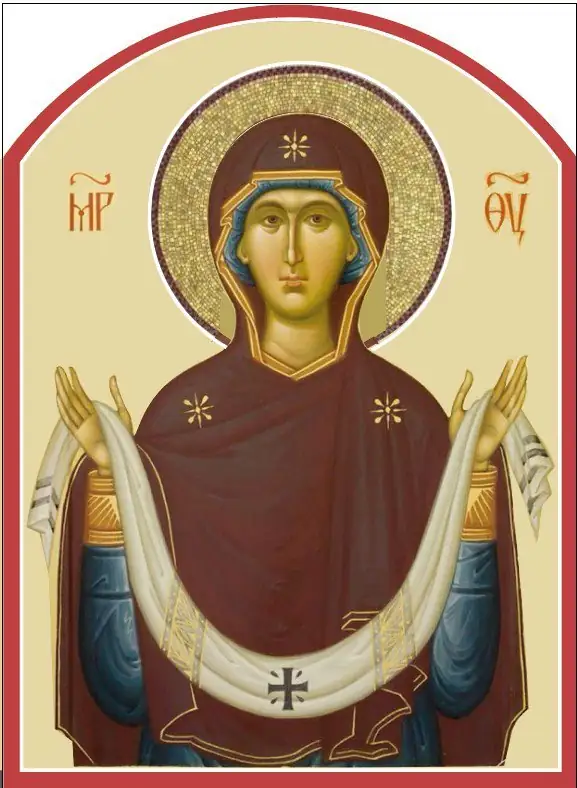
Mosaic icon of the Protection of the Theotokos for a church facade
The Church of the Protection of the Theotokos in the village of Cherdakly, Ulyanovsk region, asked us to make a mosaic icon for its facade. We assembled it in our own split smalti with gold smalti, installed it in one piece, and it was consecrated at Easter.
Like this project?
We will make a mosaic like this for your space: an artist proposes a sketch, a manager calculates the cost and timeline. The consultation is free.