
How a mosaic restoration estimate is built
No two restoration estimates look alike, because no two damaged mosaics are alike. Using published public tenders for Soviet-era mosaics and our own practice, here is what an estimate is made of and what drives the cost.
It starts with a survey
An estimate is only as good as the survey behind it. A restorer visits the site, records the size of the mural, the material and the size of the tesserae, and photographs the whole work and every area of damage. The mosaic layer is tapped to find tesserae that have lost adhesion, the substrate is examined, and samples of smalti, stone or glass are taken so the material can be matched.
The result is a condition report: how much of the surface is lost or loose, what caused it (usually weather, sometimes people), what state the substrate is in, and which parts can be conserved in place. That report sets the plan of work and the cost.
Heritage sites need project documentation first
When a mosaic is a listed cultural heritage object, the restoration itself is preceded by scientific and design documentation, which is a separate piece of work with its own budget. Our first example is the tender for the documentation to restore the relief on the facade of the Central Economics and Mathematics Institute (CEMI) in Moscow. Such documentation includes, among other things:
- engineering surveys by geodesists, hydrologists and geologists;
- historical research, such as work with archives;
- chemical and technological analysis of the building and finishing materials.
What the works themselves include
Our second example is the tender for restoring the mosaic on the "Folk Art" relief in Volodarsk, Nizhny Novgorod Region, with a mosaic area of 112 m². Its estimate was made up of, among other items:
- photographic recording of the surviving mosaic and reconstruction of the design;
- a detailed inspection;
- removal of the parts of the mosaic layer that were coming away;
- removal of the crumbling parts of the relief and strengthening of the load-bearing wall;
- a temporary waterproof cornice above the mosaic;
- remaking the lost parts of the relief;
- preparing sections of the mosaic for transport and installation.
What drives the cost
Area is only the starting point. In the published tenders we reviewed, the cost per square metre varied considerably between projects: the 112 m² Volodarsk relief and the 544 m² "Joy of Labour" mosaic stele, restored as part of a major renovation, came out at quite different rates per m². The main factors are:
- Area: the total surface, and how much of it actually needs work.
- Percentage of loss: a mural with scattered loose tesserae costs far less than one where whole slabs must be remade.
- Material matching: whether stock smalti can be used or colours have to be developed and melted to match the original; glass and stone may need specialist suppliers.
- Substrate: whether the wall, relief or base also needs repair.
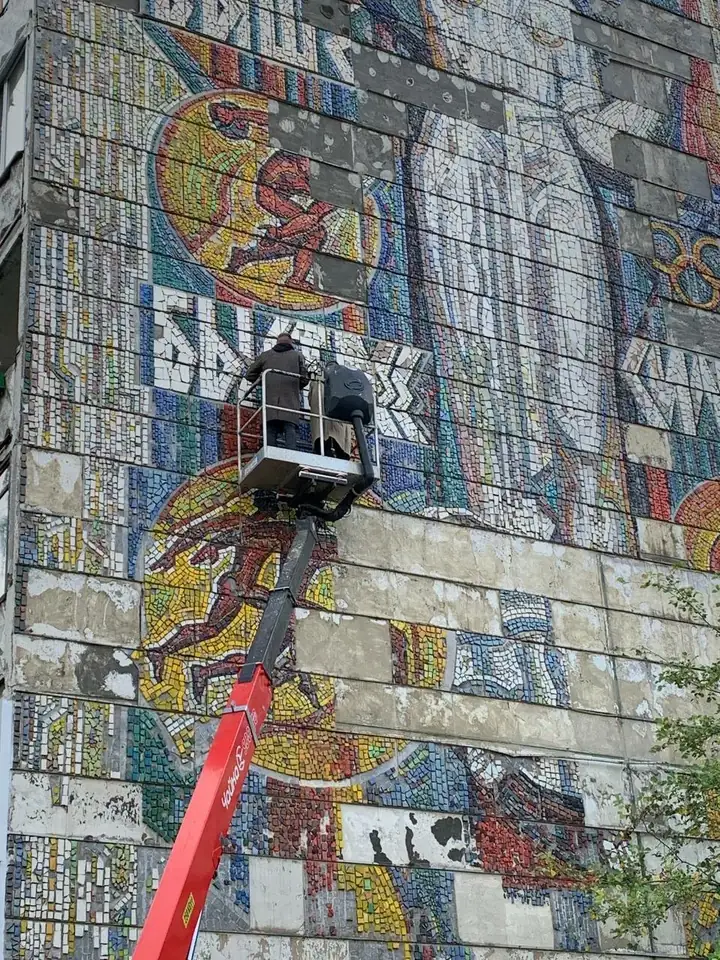
- Access: scaffolding, aerial platforms, cranes, fencing and site set-up.
- Scope: conservation and cleaning of the original in place, or removal, reassembly in the studio and reinstallation.
- Logistics and conditions: transport of the mosaic, travel and accommodation for the team, work in winter and a reserve for unforeseen work.
- Supervision: on heritage sites, scientific guidance and author's supervision appear as a separate line, as in the tender for the Kazan Church of the Resurrection Novodevichy Convent in St Petersburg.
How we prepare an estimate and proposal
After the survey, our project manager brings the data together into an estimate and a commercial proposal. It covers materials and their transport, colour matching in our smalti workshop, installation, the working time of smalti makers, restorers, the production manager and the project manager, and other costs specific to the project. We use our own costing system and check it against current market prices.
We have taken part in many mosaic restoration projects in different cities and abroad, working with city administrations, companies and private owners, and have saved a number of mosaics that were close to being lost. Contact us if you need mosaic restoration specialists: we will advise you, survey the site, prepare an estimate and proposal, and restore the mural to its original appearance.
Photos
10 photos — click to enlarge.
Questions and answers
Can you give a price from photographs?
Photographs help us give a first idea of the scope, but a reliable estimate needs a site survey: tapping the mosaic, examining the substrate and taking material samples.
Is restoration priced per square metre?
Area is the starting point, but the rate per square metre depends on the percentage of loss, material matching, the state of the substrate, access and whether the work is conservation in place or full restoration.
Why does a heritage mosaic cost more to restore?
A listed mosaic usually needs scientific and design documentation before work starts, including historical and materials research, and scientific guidance and author's supervision during the work.
Do you work outside Russia?
Yes. We work worldwide: we survey the site, match and make the smalti in our own workshop, and bring the team to install the work.
Planning a mosaic?
Tell us what and where you would like to place — our artist will suggest a sketch and we will calculate the cost for your space and timeline. We reply within one working day.