
Mosaic restoration
We restore mosaics in smalti and mosaic tile from different periods, working with city authorities, churches and private owners. Every project starts with a survey on site, and we make replacement smalti to match the original in our own furnace.
Our approach
Our team includes restoration artists with professional training and long experience. Many mosaics from the Soviet era and other periods are in poor or even dangerous condition and need urgent work. Too often the original smalti tesserae are replaced with unsuitable materials, or the mosaic is simply knocked down without any attempt to save it.
Before we start, we run dozens of trials to come as close as possible to the original mosaic layer. We aim to keep our intervention minimal and as discreet as possible, respecting the author's structure and intent. For us restoration means preserving the work, not creating something new at the cost of the original.
How restoration is priced
The cost of restoration cannot be given from a photograph: it depends on the area of the mural, the share of losses, the material and the height. So the work begins with a survey on site, and we prepare the estimate from its results. If you already have a survey or a restoration project, we can price from that.
The survey includes a restorer's visit, tapping and photo documentation, a map of losses, palette selection and a condition report with recommendations. The estimate then covers work over the whole area (cleaning, raking out and regrouting joints, protective coating) and, separately, replacement of losses according to the map, material matched to the original, and scaffolding if the mural is higher than 3.5 m.
Smalti matched to the original
We take samples on site, develop the recipe in our laboratory and run trial melts until the shade matches. For a mosque dome we made about 20 samples of blue and light blue smalti with gold ornaments. For a memorial in Nizhny Novgorod we made about 1,500 kg of smalti identical to the original.
Heritage sites
Work on listed cultural heritage sites must be carried out by an organisation that holds the required heritage licence. The studio does not hold its own licence, so on such sites we work as part of a licensed general contractor's team: the contractor is responsible for the project, approvals and supervision, and we are responsible for the mosaic.
If a mural is not listed or under consideration for listing, no licence is needed and we contract directly. This is the case for most Soviet-era murals on facades and in schools, summer camps and community centres.
Our part of the work: mosaic survey, loss mapping, smalti matching and melting, and restoration of the setting. The team are restoration artists trained at the Glazunov Academy, the Surikov Institute and the Stroganov Academy. Documents: condition report, estimate, before-and-after photographs and a certificate of completion.
Where we have restored mosaics
- Moscow: mosaic of the Church of the Ascension at the Nikitsky Gates
- Moscow: mural by V. A. Frolov on the Shekhtel mansion
- Moscow: smalti for the Pioneer Badge monument on Sparrow Hills
- Moscow: murals of the Pervomaisky cinema
- Mural in the grounds of a military clinical hospital
- Nizhny Novgorod: Memorial of Glory of the Sokol plant, 7 Chaadaeva Street, dismantled, restored and remounted
- Nizhny Novgorod: Soviet broken-smalti mural in the Park of Glory, 2022
- Nizhny Novgorod: Faster, Higher, Stronger by V. V. Lyubimov, dismantled, restored and returned to the facade in 2023–2024
- Naro-Fominsk: We Will Build Our New World on a factory facade
- Novomoskovsk: 1974 mosaic on the facade of the Azot community centre
- Sarov: mosaic stele with a portrait of Lenin
- Toropets: mosaic stele
- Yaroslavl: The Oath of Prince Pozharsky
- Lipetsk: ceramic tile mural in a pedestrian underpass
- Kabardinka: Childhood mural at the Albatros children's camp
- Tatarstan: Soviet mural at a children's camp
- Mongolia: mural at the Zaisan memorial complex, Ulaanbaatar
- Conservation: a 1970s–80s mosaic moved to a new base from a building due for demolition
How we work
Photos and consultation
Send us photos and the dimensions of the mural. We tell you what we can see, whether urgent protection against loss is needed and what to check on site. Free of charge.
Survey
We visit the site, tap the base, make cleaning tests and take smalti samples, then hand over a condition report. Paid before the visit.
Estimate and contract
We price the work and materials from the loss map, agree the method and timing, and melt smalti to match the original. 50% advance.
Work on site
Consolidation and removal of detached areas, cleaning, replacement of losses, toning and grouting, protective coating.
Handover
Before-and-after photo report and a certificate of completion, with a 24-month guarantee. The remaining 50% is paid on signing.
Our projects
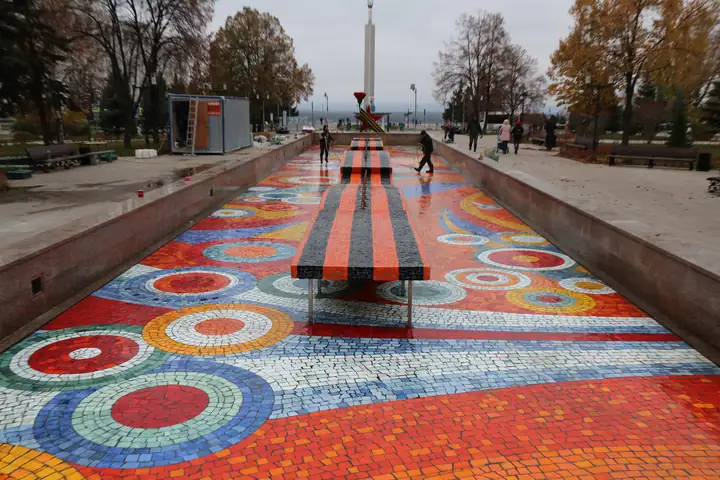
280 m² of new smalti for the 30 Years of Victory fountain in Samara
Restoring the mosaic of the 30 Years of Victory fountain in central Samara is one of the largest projects we have taken part in. In just over four months we developed and melted hundreds of new smalti colours and assembled more than 280 m² of mosaic.
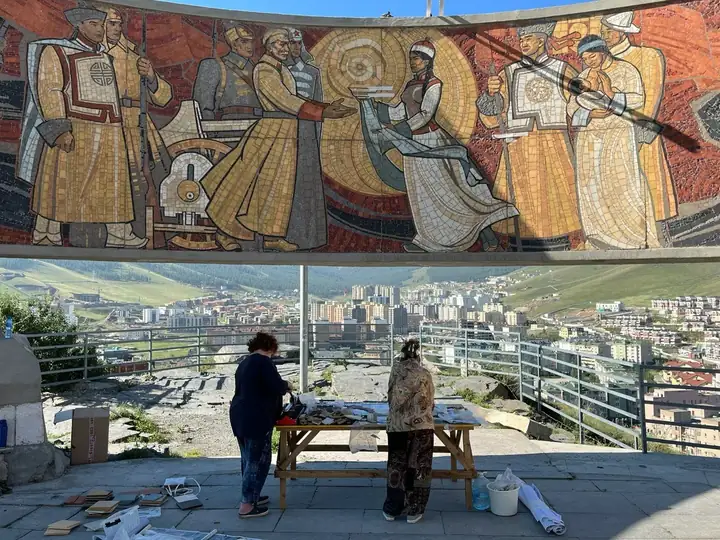
Restoring the mosaic ring of the Zaisan memorial in Ulaanbaatar, Mongolia
The Zaisan memorial above Ulaanbaatar has a huge ring of tile mosaics on Soviet–Mongolian history. Working with an Irkutsk charity foundation, our team of six spent about two weeks on site consolidating the mosaic and rebuilding its losses.
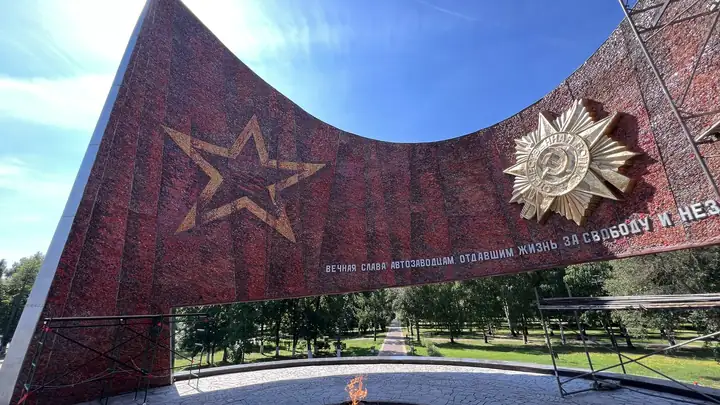
Restoring the smalti mural of the Glory Monument in Nizhny Novgorod
The 1980 Monument of Glory to the car-plant workers in Nizhny Novgorod had lost much of its smalti mosaic over four decades. In one month we cleaned it, rebuilt the failing areas and brought the 220 m² mural back to how it looked on opening day, using original tesserae and 1,500 kg of smalti we made to match.
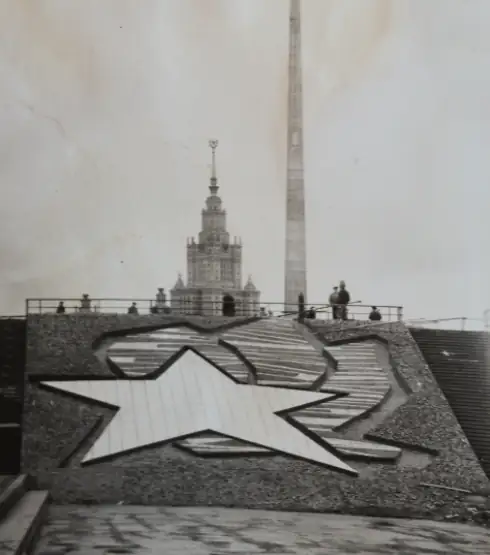
Smalti matched to Soviet samples for the Pioneer Badge monument, Moscow
We are often asked to make smalti for restoring monuments. For the Pioneer Badge on Sparrow Hills in Moscow, we matched red and blue smalti to samples taken from the monument itself and produced about 800 kg of full-size bricks so it could regain its original appearance.
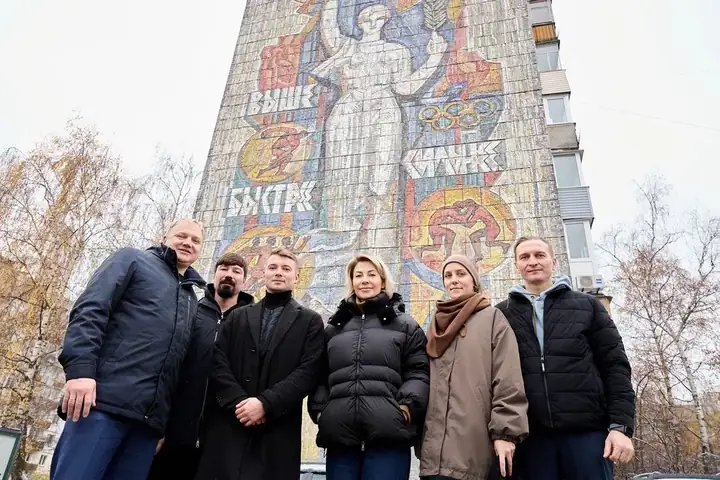
Saving the 1980 'Faster, Higher, Stronger' facade mosaic in Nizhny Novgorod
One of Nizhny Novgorod's largest mosaics, made for the 1980 Olympics, was shedding smalti onto the pavement. Over 2023–2024 we took it down, rebuilt it on new slabs in our workshop and installed it on an insulated facade.
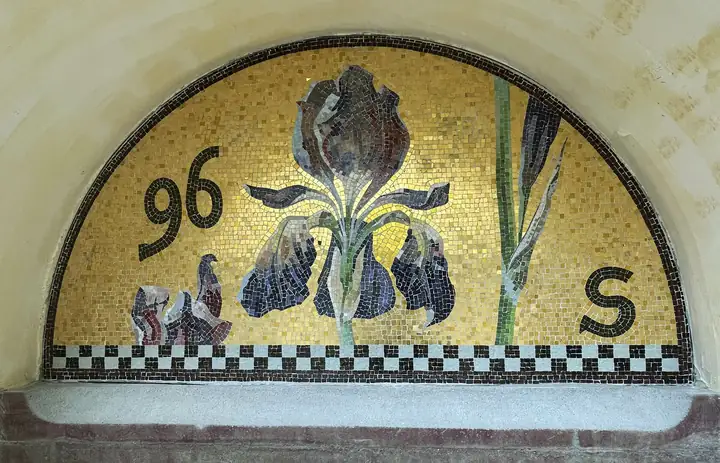
Restoring Vladimir Frolov's mosaic over the entrance of Shekhtel's mansion
Above the main entrance of Fyodor Shekhtel's own house in Moscow is a smalti mosaic made by Vladimir Frolov to the architect's sketches. Six of our specialists spent just over two weeks returning its gold background and irises to full strength.
Photos
26 photos — click to enlarge.
Questions and answers
How much does mosaic restoration cost?
We price the restoration after an on-site survey, which is itself a paid service. The cost depends on the area of the mural, the share of losses, the material and the height. Send us photos and we will quote the survey for your location.
Can restoration be priced from photos?
Approximately, yes: photos show losses, chips and efflorescence. We give an exact estimate only after a survey, because voids under the setting and detachment of the base can only be found by tapping on site.
Is a heritage licence required?
For work on a listed heritage site, yes: the contractor must hold a licence. The studio does not have its own, so on listed monuments we work within a licensed general contractor's team and are responsible for the mosaic. If the mural is not listed, no licence is needed and we contract directly.
Where do you get smalti in the original colour?
We make it ourselves. We take samples on site, develop the recipe in our laboratory and run trial melts until the shade matches.
Can a mosaic be taken off the wall and moved?
Yes. If the base is failing, we dismantle the mural, restore it in the studio and reinstall it, or move it to a new base. We did this with the memorial in Nizhny Novgorod and with a 1970s–80s mosaic from a building due for demolition.
What guarantee do you give, and how is payment structured?
The guarantee is 24 months from the certificate of completion, provided the causes of damage, such as leaks and condensation, have been eliminated. The survey is paid before the visit; the work is paid 50% in advance and 50% on signing the certificate.
When can a facade mosaic be restored?
Outdoors we work in dry weather at +5 °C or above. In colder months work is possible with an enclosure and heating, which is quoted separately.
Do you work in other countries?
Yes. We have restored mosaics in many Russian cities and in Mongolia, and we make matching smalti for projects worldwide. The site visit is included in the survey price.
Planning a mosaic?
Tell us what and where you would like to place — our artist will suggest a sketch and we will calculate the cost for your space and timeline. We reply within one working day.