
How we make smalti for mosaic restoration
For several years we have made our own materials, both for new mosaics and for restoring old ones. Good restoration depends on understanding how the material is made and seeing the whole process from the inside. Here is every stage of making smalti, from choosing the colour to cutting it into tesserae.
Steps 1–2. Choosing the palette and the type of smalti
Once the overall project plan is agreed, we study the mosaic being restored again to match the palette precisely. The number of colours and the colours themselves determine everything that follows.
First we propose several different compositions and test them by firing them in the kiln. Together with the client we choose the closest option and approve it. Only then does the smalti workshop start producing the main batch.
How smalti is made depends on its type. Ordinary coloured smalti is fired in special kilns. Gold leaf smalti is harder to make: it is built from layers of clear glass with a sheet of gold leaf between them. Smalti can be made in two ways, melted or baked, and the two differ slightly in colour saturation.
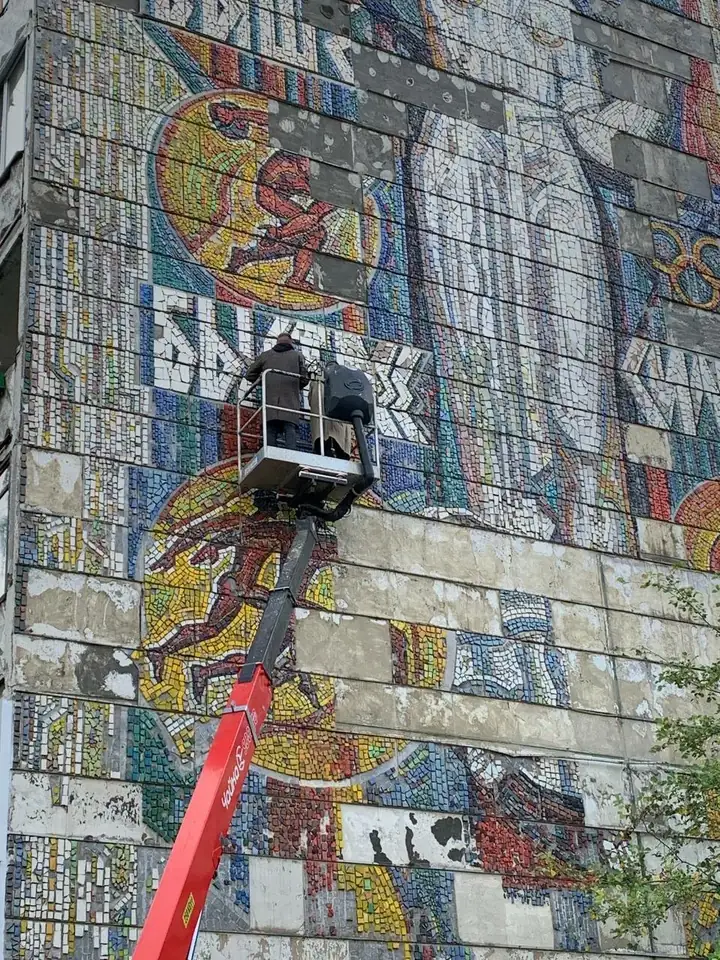
For the "Faster, Higher, Stronger" mural in Nizhny Novgorod we made smalti in a range of colours, which was then set into the lost and loosely fixed areas of the mural.
Step 3. Preparing the mix
We mix the batch, the raw material for glass (soda, chalk, quartz sand and so on), with a colourant. The amount of colourant is critical: the slightest error in the calculation and the colour is no longer the one we need.
Steps 4–5. Melting, shaping and annealing
During melting the temperature can reach 1,400 °C. When the batch has melted in the crucible, the smalti makers ladle it out and pour it into prepared moulds. As soon as the smalti sets, it goes into a second furnace to cool slowly, which prevents internal stress in the material.
Smalti cannot be left to cool at room temperature: the outside of the cake would cool faster than the inside, and it could crack. Firing and cooling must be even and follow a set temperature schedule.
Step 6. Cutting
When the smalti has cooled, we either send the cakes to the place where the mosaic will be assembled, or cut them into tesserae of a set size. From there the work moves on to the next stages of making the mosaic.
The ArtWorker smalti workshop
In the workshop laboratory we are always developing new recipes to hit a given sample exactly. Since we started making smalti in 2017, we have produced more than 10,000 colours and shades with different textures, levels of shine and hues. The palette grows every year, which helps us match a colour quickly and make smalti for restoring mosaics of any period.
More than 200 colours of ArtWorker smalti are always in stock, and any other colour can be made to order or matched to a sample.
We restore and conserve mosaic murals and can help you estimate the cost of the work and answer any questions.
Photos
13 photos — click to enlarge.
Planning a mosaic?
Tell us what and where you would like to place — our artist will suggest a sketch and we will calculate the cost for your space and timeline. We reply within one working day.