
Roman geometric mosaic floors: Greek key, guilloche and wave patterns
A Roman mosaic floor has three parts: a border around the edge, a quiet field in the middle and a medallion at the centre. A dozen ornaments, from the Greek key and the guilloche to the wave, chequerboard and lozenges, combine into thousands of different floors. We drew 21 floors for entrance halls, living rooms, bathrooms, pools and hotel lobbies, took apart every ornament and explain how to choose a pattern for your room.
The anatomy of a Roman floor
Geometric ornament is the oldest and most durable language of floor mosaic. From the second century BC Romans laid floors of small stone cubes, tesserae, in a technique called opus tessellatum. A figurative picture with people and animals, the emblema, was expensive and made in a workshop; the rest of the floor was filled with geometry, which was quick to set out and never grew tiresome.
That is why geometry is what survives best: in Pompeii and Herculaneum, in Ostia near Rome, in Aquileia and at the Villa Romana del Casale in Sicily. The Greek key, the guilloche and the wave passed from there into Byzantine churches, into Victorian encaustic tiles and parquet, and now into homes, restaurants and hotels.
Every Roman geometric floor reads the same way. The border is one or more bands of ornament along the walls. The field is a quiet repeating pattern in the middle. The centrepiece is a medallion, or a grid of panels if the room is large. Designing a floor comes down to three choices: which border, which field, and whether it needs a centrepiece.
Borders: Greek key, guilloche, wave and seven more
The border frames the floor and sets its character. Roman mosaicists sized each motif so that a whole number fitted along every side, with a square or a loop turning the corner. Border height is counted in rows of tesserae: with 10 mm tiles, nine rows come to about 11 cm. Several bands are stacked and separated by a dark line.
A continuous line turning at right angles and hooking back on itself, named after the winding Maeander river in Asia Minor. The most recognisable classical ornament, crisp from across the room. 9 rows; at 14 rows the line is two tiles wide.
The “castle wall”: the line steps up, across, down and across again, without the hook. Calmer than the full Greek key; good for corridors and small floors. 7 rows.
Two interlaced strands with a dot in every loop. Romans framed medallions with it and used it to divide bands. It loops at the corners and runs unbroken around a circle. 9–12 rows.
Three strands give a dense, festive plait: a wide border for floors over two metres and formal halls. About 20 rows.
A wave line with a change of tone: light “sky” above the crest, dark water below. Bends around corners without a break, so it suits pools, bathrooms and round medallions. From 20 rows, 20–24 cm.
A row of spiral crests, the Vitruvian scroll. One of the liveliest classical borders: it seems to move along the wall. 16–20 rows.
Stepped teeth rising from a line at the edge. Dark teeth on pale stone are the classic edging of the floors at Ostia. 6 rows.
A line with squares at intervals, the mosaic version of the dentils on a classical cornice. A narrow band that separates border from field. 3 rows.
A two-tile chequered band. The simplest border of all, yet it instantly makes a floor look Roman. 4 rows.
A broken line from edge to edge: a lively band for bathrooms and contemporary interiors. 8 rows.
Field patterns: chequerboard, lozenges, crosses, fans, scales
The field is the largest part of the floor, so its pattern is small and calm: it keeps the rhythm and does not compete with the border. The field divides into whole cells, so nothing is cut off at the border. A cell is usually 5–8 tiles, 6 to 10 cm. Under a medallion, choose the quietest fields: crosses, grid or lozenges.
Squares in two colours, the best-known geometric floor. Black and white is the classic of Ostia.
The chequerboard turned through 45°. More decorative, and it makes a corridor look longer.
Fine lines in a grid with a dot in every square: a light floor with a delicate pattern.
Small crosses in a chequer arrangement: the quietest Roman floor and the best background for a medallion.
Rows of fans like opened shells. A classic of Roman baths and pools, possible in four tones with a colour gradient.
A field of scales, each in its own colour: a colourful floor without a picture, for bathrooms and kitchens.
Rings spreading from the centre, for a rotunda, a round medallion or a floor with a single central figure.
Bands with a wave line and tonal shift: a “sea” field beside a pool.
Medallions and centrepieces
A medallion gathers the floor around the centre of the room. It can be a circle, square, lozenge, octagon, hexagon or rectangle, with its own border, its own field and a figure in the middle. Each part of the figure is laid in rows following its own outline, petal by petal and lozenge by lozenge, so it reads even when furniture covers part of it.
In a large room a grid of panels replaces the single medallion, each panel with its own frame, pattern and figure. This is how the floors of Roman villas were organised, and it is the easiest way to divide a long corridor or a dining room.
Petals around a centre, from six to sixteen of them: the most common figure in Roman medallions.
Two-colour lozenge rays forming an eight-pointed star, the centre of an octagonal medallion.
Curved blades in two colours, like a turning wheel. It gives the floor movement.
A lozenge within a lozenge: a strict figure for a lozenge medallion or a panel.
A circle within a circle, the simplest figure for a small medallion or a pair of medallions.
Entrance halls, corridors and stairs
The entrance floor is seen first and walked on most. Strict fields work best here (chequerboard, lozenges, grid) with a border that follows the shape of the space. A long corridor is better divided into panels: the eye moves from one to the next and the corridor feels shorter. A small inset at the door or by the fireplace gives you a Roman floor without tiling the whole room; we cover such insets in detail in Mosaic doormat designs.
The corridor is divided into four squares and the eye moves from panel to panel. The border is the simple key; the panels hold a rosette, a star, a whirl and nested circles.
The black and white floors of Roman Ostia: a Greek key around the edge, a row of dentils and a chequerboard field. Strict enough for classical and contemporary interiors alike.
A lozenge field, a chequerboard set on the diagonal, makes a narrow corridor look wider. A guilloche outside, stepped triangles next to the field.
For a square entrance hall the square medallion echoes the room. A Greek key around it, nested circles at the centre and a fine grid in the field.
A small 1.2 m square: a guilloche around the edge, looping in the corners, and a round medallion with a rosette turn the landing into a feature of the house.
A small mosaic rug in front of a fireplace or a door: key and dentils at the edge, a lozenge field and a lozenge medallion with a rosette.
The same Roman language in grey marble and polished stone: a simple key, a grid and a square with nested lozenges. Geometry without the museum feel.
Living rooms, dining rooms and halls
In a large room a Roman floor is built around the centre: a round, octagonal or hexagonal medallion, or a grid of panels as on villa floors. The border is wider here, two or three bands of ornament separated by a dark line: a bold key or wave outside, small dentils or chequers next to the field. The medallion takes from half to two thirds of the shorter side of the field.
A formal 4.8 × 2.4 m floor: a two-tile-wide Greek key, a lozenge field and three round medallions in guilloche frames holding a star, a rosette and a whirl.
A classic of Pompeian houses: a key and chequer border, a field of crosses and a round medallion with a running wave and a guilloche around a twelve-petal rosette.
A wide multi-band border marks a formal Roman floor: running wave, guilloche and dentils separated by dark lines, with a chequered panel framed in Greek key at the centre.
A grid of six square panels as on villa floors, each with its own field and figure: star, whirl, nested lozenges, rosette. The shared border is a triple guilloche.
Rings spread from the centre, where a hexagon with a wave outline holds a six-bladed whirl. A floor in motion for a room that has a centre.
In a round hall the medallion takes the whole floor: wave and key around the circle, rings spreading inside from a sixteen-petal rosette. Lozenges fill the corners.
Green marble and pale stone: a running wave around the edge, a fine grid in the field and an octagon in guilloche with an eight-bladed whirl.
Bathrooms, pools, kitchens and terraces
Roman baths are where the mosaic floor by the water was born, and with it the wave, the fan and the scale, the sea palette and the octagon with a star. Mosaic is not afraid of water or steam, and the many joints of small tesserae act as a non-slip texture. For kitchens and terraces, a warm palette of terracotta, ochre and pale stone.
A long strip of floor by the water: a tonal wave around the edge, a sea of scales in the field and two round medallions with nested circles.
A field of fans, the classic of Roman baths, in four tones of water with a colour gradient. At the centre an octagon in guilloche with a lozenge star.
A sea palette for a bathroom or hammam: a field of scales, an octagon outlined with a wave and a lozenge star.
A pale field with a fine grid and a dot in every square, edged with a cobalt zigzag. A calm floor whose pattern does not break up a small room.
A warm floor in terracotta and ochre: a field of scales, each in its own colour, with stepped triangles and a chequer band around the edge.
A fan field without a medallion, warm tones blending smoothly, with a wave around the edge. A floor that looks good empty and under furniture.
A lozenge inscribed in a rectangle is a common Roman scheme. Nested lozenges inside, a calm field of crosses around them and a Greek key at the edge.
Roman geometry in a contemporary interior
Roman geometric ornament is not tied to one style: the same Greek key looks ceremonial in marble and ochre and severe in graphite. Style comes from the colours, the width of the border and whether there is a medallion. The same borders work beyond the floor, too: a frieze on a bathroom wall, stair risers, a pool edge, a tabletop.
- Classical and neoclassical
- A key around the edge, a round medallion with a rosette, pale marble with ochre and terracotta. A Roman floor naturally continues columns, mouldings and a fireplace, and anchors the centre of a formal room.
- Mediterranean and loft
- Chequerboard, lozenges and scales in terracotta and ochre, or the black and white geometry of Ostia. It sits easily with concrete, timber and exposed beams: geometry is older than any style.
- Minimalist
- A pale field and a single border band (a simple key or dentils) in one or two colours of polished stone. The Roman language without the museum feel.
- A mosaic rug in the floor
- The most frequent commission is not a whole room but a bordered “rug” set into porcelain tile, parquet or stone: in a hallway, under a dining table, in front of a fireplace. A brass or stone profile finishes the joint.
What the ornaments mean
Romans chose ornament not only for its beauty. Each motif is traditionally given a meaning:
- Greek key: infinity and continuous flow, a line without an end.
- Guilloche: union and unity, strands that interlace and never part.
- Wave: water, the sea and the baths, which is why it is so popular around pools.
- Rosette: the sun and a flower, the centre the floor gathers around.
Lettering, a monogram or a house number can be worked straight into the border or medallion, like the Roman SALVE at a threshold. See examples in Mosaic doormat designs.
Seven rules for composing a Roman floor
We tested these rules in ANDAMENTO Studio, building the same floors with different borders, fields and medallions and seeing what reads and what blurs. They work just as well for a floor you design yourself.
Start with the border
Bold and calm on the outside: a Greek key or a wave. Small next to the field: dentils or chequers. The guilloche goes between them or around a medallion.
Separate bands with a line
A plain dark band one or two tiles wide stops two ornaments merging. Two patterns side by side read as a blur.
Three or four colours for the whole floor
Pale stone, a dark line, one or two colours. Use the same colours in the border, field and medallion and the floor looks unified.
Size the medallion to the field
Half to two thirds of the field's shorter side. The figure inside is about 0.4 of the medallion's inner diameter.
One tessera size for the whole floor
10 mm for floors from 1.2 m, 12–15 mm for floors from 2.5 m. The larger the room, the larger the tile: the pattern must read from the door.
A wave needs height
The wave and running wave read from 16–20 rows of tiles. On a small floor use the key or the guilloche, which need only 9–11 rows.
Match the border to the room
The key and stepped triangles run along straight sides and around circles. Octagons, hexagons and walls with projections take a guilloche or a wave, which bend around any corner.
Materials
Romans laid their floors in chipped marble and limestone. We work with the same stone, adding smalti from our own furnace and glass mosaic tile for colour accents and wet areas. Do not confuse Roman mosaic with terrazzo: terrazzo is poured and ground, so its design can only be made of large areas. Roman mosaic is set by hand from individual tesserae, which is what makes the Greek key, the guilloche and finely drawn medallions possible.
- Chipped marble
- Natural stone, 8–15 mm tesserae. A matt surface with an antique texture that is not slippery; ground and sealed after laying. White, black, ochre, terracotta, green and pink, the colours of Roman floors.
- Smalti
- Coloured glass we melt ourselves, with deep colour that does not fade. For medallions, accents and floors with moderate traffic.
- Glass mosaic tile
- For bathrooms, hammams and pools: it does not absorb water and is easy to clean. Frost-resistant tile works on terraces and porches.
- Base and care
- A level screed and waterproofing in wet areas; the mosaic is compatible with underfloor heating. Care is ordinary wet cleaning: Roman floors have lasted two thousand years.
Floor size, tesserae and border
| Floor | Where | Tesserae | Border and centrepiece |
|---|---|---|---|
| Up to 1.5 m | Stair landing, inset at the door or fireplace | 10 mm | One band: key, guilloche or chequers |
| 1.5–2.5 m | Entrance hall, bathroom, study | 10 mm | One or two bands, optional medallion |
| 2.5–4 m | Living room, dining room, kitchen, terrace | 12 mm | Two or three bands, a medallion or panels |
| Over 4 m | Hotel lobby, restaurant | 15 mm | Wide border, several medallions |
How to order a Roman mosaic floor
We can make any floor on this page to your size and colours, or design a new one from your room plan, including irregular rooms: the border will turn around projections and alcoves. You can also order just the design, with the tile layout and stone quantities, if your own installer will lay it.
Plan and photos
Send the room dimensions or a plan with doors, and a few photos. Tell us which floor on this page you like and the colours of the interior.
Design
We build the floor in ANDAMENTO Studio, where every tessera is visible, the border fits your walls and the medallion sits on the centre of the room. You see two or three options.
Stone and samples
We choose the marble and smalti and show you samples and a trial fragment.
Workshop assembly
The floor is set on mesh in our studio following the layout maps, so on site only installation remains.
Installation and finishing
We lay, grout, grind and seal the stone. For projects abroad, travel and shipping are quoted separately.
We price each floor from the design, by area, stone and complexity: a field of crosses is quicker to set than a guilloche border with a medallion. See prices for guide rates per square metre, our Roman stone mosaic service, or earlier Roman-style work: a mosaic bar in classical Roman technique, a stone mosaic table and a swimming pool floor mosaic.
How the floors were drawn: ANDAMENTO
Every floor in this article was built in ANDAMENTO Studio, our tool for mosaicists. A floor is described in three words (border, field, centrepiece) and Studio places every tessera: it runs the Greek key so a whole number of motifs fits each side, closes the guilloche with a loop in the corner, divides the field into whole cells and counts the stone by colour. The same tool drew our mosaic doormats and the unswept floors.
Questions and answers
What is a Greek key (meander) in mosaic?
A Greek key, or meander, is an ornament made of one continuous line that turns at right angles and hooks back on itself. It is named after the winding Maeander river in Asia Minor. In Roman mosaic it most often frames the whole floor or a medallion; the simpler version without the hook is called the castle wall.
Which geometric patterns did the Romans use?
In borders: the Greek key, guilloche, wave and running wave, stepped triangles, dentils, chequers and zigzag. In fields: chequerboard, lozenges, grid, crosses, fans, scales and rings. In medallions: rosettes, lozenge stars, whirls, nested lozenges and circles.
What is a guilloche border?
Two or three strands interlaced into a continuous plait, often with a dot in each loop. Romans used it around medallions and between border bands. Unlike the Greek key it bends around any corner or curve, so it suits octagons, circles and irregular rooms.
How is Roman mosaic different from terrazzo?
Terrazzo is poured with stone chips and ground flat, so its design is limited to large areas divided by metal strips. Roman mosaic is set by hand from individual tesserae, which allows fine ornament such as the Greek key, guilloche and wave, and medallions with figures.
Can a Roman mosaic floor go over underfloor heating?
Yes. Stone and glass conduct heat well, and the mosaic is set in a flexible adhesive rated for heated floors. The base must be level and sound.
Is a mosaic floor slippery in a bathroom?
Chipped marble is matt, and small tesserae create many joints that work as a non-slip texture. For pool surrounds we choose stone with a rougher surface.
Can you make a floor for an irregular room?
Yes. The guilloche and the wave turn around any corner or projection, and the field adapts to the outline of the room. We showed how ornament follows a room plan in [The unswept floor](/blog/unswept-floor-roman-mosaic).
Can lettering or a logo be added to a Roman floor?
Yes: SALVE at the threshold, a house number, a hotel or restaurant logo in the medallion. See examples in [Mosaic doormat designs](/blog/mosaic-doormat-designs).
How much does a Roman mosaic floor cost?
We quote from the design: the price depends on the area, the stone and the complexity of the ornament. Guide rates per square metre are on our [prices](/prices) page.
Can I order only the design?
Yes. We draw the floor in ANDAMENTO Studio with every tessera laid out and the stone counted by colour, so your own installer can lay it.
Related services
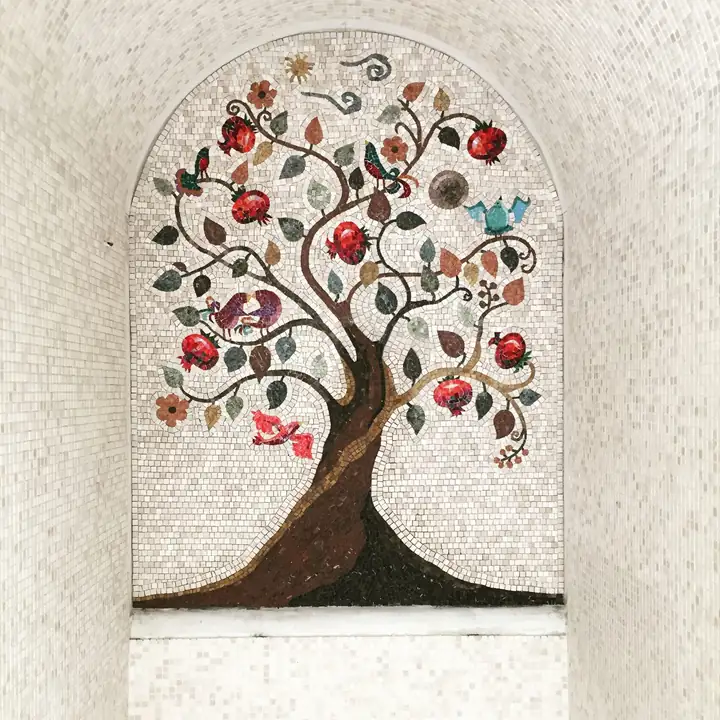
Roman mosaic in natural stone
We design and make mosaics in the Roman technique from marble, other natural stone and smalti, and install them on site: floors, feature walls, worktops, kitchen splashbacks and hammams.
From $1,260 per m²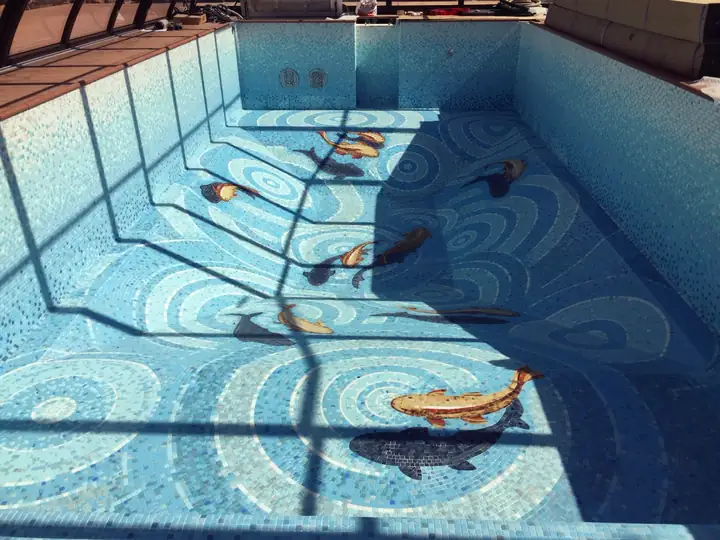
Glass mosaic murals for pools, bathrooms and interiors
We make artistic glass mosaic for swimming pools, interior murals, bathrooms and kitchen splashbacks, working from your sketch or designing an original one to your brief.
From $930 per m²Planning a mosaic?
Tell us what and where you would like to place — our artist will suggest a sketch and we will calculate the cost for your space and timeline. We reply within one working day.