
The unswept floor: a Roman mosaic joke in five modern rooms
Two thousand years ago a Greek master laid a floor that looked as if nobody had swept up after dinner. We took his idea into marble for today's rooms: a car workshop, a nursery, our own mosaic studio, a gamer's den and a round zoo pavilion. Here are the five designs, the rules behind them and how to commission a floor of your own.

The Roman original: a floor nobody swept
Ancient floor mosaics were rarely just decoration. They were meant to be walked on, looked at and talked about, and sometimes they played tricks on the guests.
Pliny the Elder tells of Sosus of Pergamon, who made a floor called asarotos oikos, Greek for “the unswept room”. Across a pale ground lay what was left after a feast: fish bones, shells, nutshells, grape stalks and leaves, each with a small shadow, so the scraps seemed to lie on the floor rather than in it. Sosus's own work is lost, but Roman copies survive. The best known, signed by Heraclitus in the 2nd century AD, is now in the Vatican Museums, and in one corner of it a mouse is busy with a nut.
The joke has a serious side. The floor tells you about the house: what its owners ate, how they lived, how well they entertained.
Six rules we kept from the Romans
The idea stays Roman; only the objects change. Instead of leftovers from a banquet, each floor is scattered with the things of one particular room, so you can tell at a glance where you are.
- Marble
- Ancient floors were laid in stone, and so are ours: every design is calculated for 8 mm marble tesserae.
- Scattered, not arranged
- Objects fall at random places and angles, big and small mixed together, with every shadow cast the same way.
- True to scale
- A fuel can is bigger than a spanner and a bucket is bigger than a mug. Real proportions are what make the illusion work.
- Andamento around each object
- Close to every object the ground follows its outline row by row, then settles into a calm running bond.
- Three tile sizes
- About 13 mm for the ground, 7–10 mm for the objects and 5 mm for fine outlines. The Romans worked the same way: fine tesserae for figures, coarse for the field.
- Pale field, Roman border
- Warm whites for the ground, and a border of alternating tiles, a guilloche braid or a running wave. The field itself can be laid in fans or scales.
Five floors in the ARTWORKER series
For now these are designs: full-size sketches, project sheets and renderings of each floor in a room. Every one can be laid at full size, because the dimensions, the number of tiles and the amount of stone are already calculated. Each object on a floor is also a finished mosaic sketch in its own right and could be made as a separate panel; click any of them to see it large.
01 · ARTWORKER AUTO: a car workshop floor
Made for a garage or a car service bay. Across the pale marble lie a wheel and tyres, a toolbox, a fuel can, an exhaust, a steering wheel, spanners, gears, nuts and washers, with a mouse in the corner. In the middle sits a round emblem with a gear and crossed spanners above the words ARTWORKER AUTO.
02 · ARTWORKER KIDS: a nursery floor
In the centre, set at an angle, lies a play rug with roads, ponds and little houses. The rug is mosaic too, with two toy cars parked on it. Around it the toys are strewn about: building blocks, a robot, a teddy bear, a ball, a dinosaur, a rocket, a train, a dump truck, crayons, a xylophone and a pair of socks. This is the brightest floor of the series, with red, blue and yellow stone among the whites.

CAVE MUREM, “beware of the mouse”, is our nod to the CAVE CANEM, “beware of the dog”, that Romans laid at their doors. Like the mouse in Heraclitus's floor, ours is a small living detail: find it on four of the five floors.
03 · ARTWORKER · MOSAIC: a mosaic studio floor
A floor about our own trade. At its centre is a panel on a board: a striped fish, as on ancient floors. Around it lies everything you find underfoot in a mosaic studio: a sack of adhesive, a bucket of grout, a tree stump with a hardy for splitting stone, a mosaic hammer, nippers, a trowel, a brush, an apron, a sheet with a bird sketch, chipped smalti, heaps of glass tiles and offcuts, apple cores, a biscuit and, of course, the mouse. The two words of the inscription are separated by a dot, the way Roman inscriptions separated words.
Any shape, with Roman borders
The two newest floors test whether a Roman floor works outside a rectangle. The gamer's room follows a real floor plan with a closet niche and a bay window; the zoo floor is a circle. Both use classic Roman borders, a guilloche braid and a running wave, and fill the field with scales or with fans graded from light to dark. For the full vocabulary of Roman borders, fields and medallions, with 21 geometric floors, see Roman geometric mosaic floors.
04 · ARTWORKER · CODE: a programmer and gamer's room
An irregular room with a closet niche, a step in the wall and a bay window, covered wall to wall exactly to plan. A Roman guilloche runs along every wall: two interlaced strands of terracotta and blue-grey marble on a dark ground, with a looped knot in each corner, even on a 26 cm step. The field is laid in scales in four tones. On the floor is what is left after a night of coding and gaming: pizza in its box and half-eaten slices, a keyboard, a laptop covered in stickers, gamepads, headphones, energy drink cans, sticky notes, floppy disks, socks, noodles and doughnuts. And a real mouse is chewing the cable next to the computer one.
05 · ARTWORKER · ZOO: a round zoo floor
A round floor for a pavilion, a café or a zoo entrance. A Roman wave runs around the edge, its colour shifting smoothly from light to dark. The field is laid in fans, each grading from pale marble to sand. A trail of elephant footprints crosses the floor, and around it lie a banana skin, a cup of cola, peanuts, popcorn, a dropped ice cream, a balloon, a zoo map and, naturally, what the animals leave behind. A tortoise, a hedgehog, a rabbit, a parrot, a lizard, a frog and some snails wander about, and the mouse has found a nut.
An unswept floor for your own space
The idea works in almost any room: a café, a hallway, a bathroom, a study, a shop or a hotel lobby. Tell us about yours and we will suggest a story for the floor.
You write to us
Send the floor size, a photo or plan of the room and what should be “left lying around”: family belongings, the tools of your trade, toys, your café's tableware.
We draw the sketch
Objects at full size, an inscription and a border, shown as a whole floor and rendered in your room. A sketch by our artist starts from $80.
You get a project sheet
Dimensions, large-scale details and the marble colour groups in square metres and kilograms, so the scope of work and material are clear from the start.
We lay and install it
Our workshop lays the floor in marble and installs it. Natural stone floor mosaic starts from $1,260 per m²; a typical order takes about four weeks to make.
For projects outside our home region, travel, accommodation and visas for the installation team, packing and shipping are quoted separately. See our Roman stone mosaic service for materials and details, or browse earlier Roman-style work: a mosaic bar in classical Roman technique, a Roman still-life kitchen backsplash, a stone mosaic table and a swimming pool floor mosaic. For something smaller than a whole floor, see our mosaic doormat designs, including unswept doormats with boots, keys and an umbrella.
How we draw them: ANDAMENTO
All five floors were drawn in ANDAMENTO, our own software for mosaic makers. We build it to make sketching easier and to cover the whole path of a professional mosaic design, from the first idea to the sheet a team works from.
Want to try stone mosaic with your own hands? Our online school, online.mosaic.school, has mosaic video courses in English from a working studio.
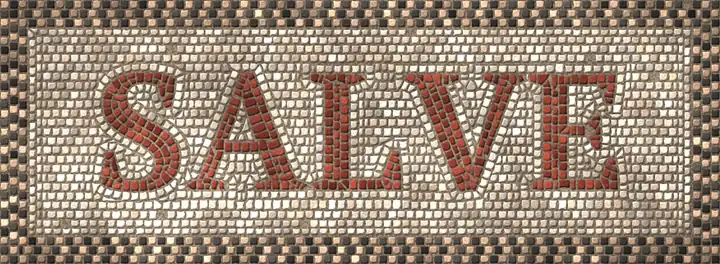
SALVE: that is how Romans greeted guests at the door. Tell us where your floor will be, how big it is and what should lie on it, and we will come back with a story and a design.
Questions and answers
Can mosaic be used on a floor?
Yes. Roman mosaic is historically a floor technique: stone takes heavy foot traffic and can be ground and refinished. Ancient floors have survived to this day.
What stone is used for a mosaic floor?
Marble from different quarries, travertine, granite and onyx, giving dozens of natural colours without any dye. The unswept floor designs are calculated for 8 mm marble.
How much does a mosaic floor cost?
Natural stone floor mosaic with cement grout starts from $1,260 per m², and a sketch by our artist from $80. The exact price comes from the design: the project sheet already lists the area and the amount of stone in each colour. Travel, packing and shipping are quoted separately.
How long does it take?
About four weeks for a typical order. Larger floors take longer; we give the timeline with the estimate.
Can I choose my own story?
Yes. Anything can be “left lying” on the floor: family belongings, tools of a profession, toys, tableware, things from your café or shop. We can add an inscription too: a name, a date or a motto.
Can the floor be round or an irregular shape?
Yes. We design to the room plan, so the mosaic runs wall to wall around niches, steps and bay windows, and the border turns every corner. Round and oval floors are possible too, like the zoo floor in this article.
Is there a warranty?
Yes, 36 months from the date the work is signed off. The terms are set out in the contract.
Related services
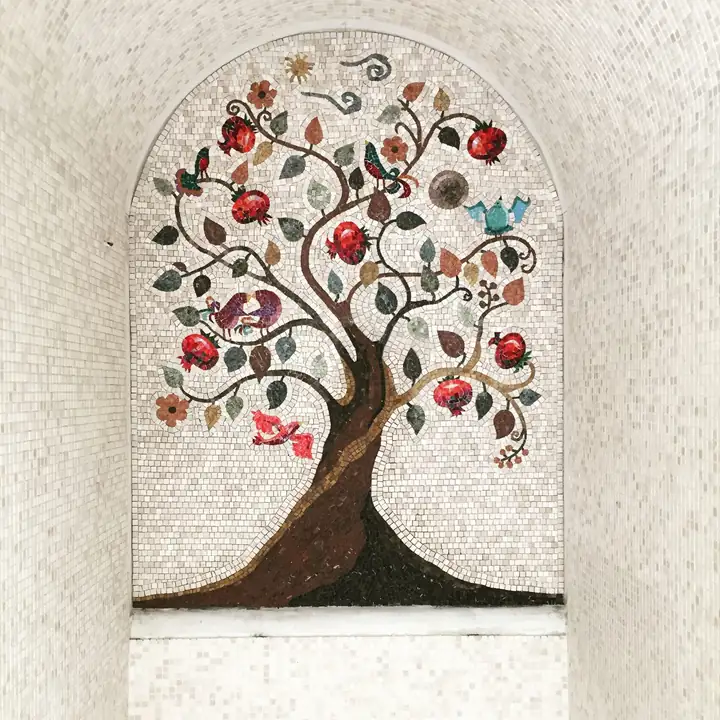
Roman mosaic in natural stone
We design and make mosaics in the Roman technique from marble, other natural stone and smalti, and install them on site: floors, feature walls, worktops, kitchen splashbacks and hammams.
From $1,260 per m²
Custom mosaic murals
We make mosaics in our own smalti, natural stone and glass mosaic tile, from a bathroom mural to building facades, church icons and monumental works. Sketch, production, shipping and installation, turnkey.
From $860 per m²Planning a mosaic?
Tell us what and where you would like to place — our artist will suggest a sketch and we will calculate the cost for your space and timeline. We reply within one working day.