
Stabilising a facade mosaic of the Church of the Ascension at Nikitsky Gate
In summer 2025 a mosaic on the bell tower facade of the Church of the Ascension at Nikitsky Gate in Moscow was close to falling and had been boarded over. Over about two weeks we bolted, injected and propped it back into a safe state.
- Location
- Church of the Ascension at Nikitsky Gate, Moscow, Russia
- Year
- 2025
- Technique
- Mechanical fixing, crack repair and injection consolidation
- Time
- About two weeks
The church
The Church of the Ascension at Nikitsky Gate is tied to many historical events. Patriarch Tikhon celebrated his last service here on 5 April 1925. In March 1928, at the funeral of the actress Maria Yermolova, Feodor Chaliapin sang here, his last performance in his homeland. Most famously, Alexander Pushkin and Natalia Goncharova were married here in 1831.
The church has been altered, extended and restored many times. In the late 2000s and early 2010s several mosaic panels appeared on the facade of the bell tower. This is the story of one of them.
Condition
The church is being restored in autumn 2025, and in summer 2025 our restoration artist examined one of the mosaics on the facade. It was in an emergency state: the mosaic had separated from the wall and could fall in pieces at any moment, and the delamination had deformed the adhesive bed carrying it. Before our work began, the panel had been covered with a wooden shield to prevent an accident. A short restoration plan was drawn up and work began.
Fixing and injection
First we removed the wooden shield. We then drilled through the mosaic into the supporting wall, especially in the critical areas, and fixed these areas with bolts. The bolts were tightened gradually, a little at a time, to reduce the deformation of the layer carrying the mosaic. Overdoing it is dangerous: after years of deformation, trying to make the mosaic perfectly flat could crack it or make parts of it fall.
Next we cleaned and filled all the cracks in the surface, so that the adhesive we were about to inject would not leak out. We then drilled holes where the delamination was worst and injected adhesive through them with construction syringes.
This was done gradually, layer by layer, each one after the previous had dried, with the mosaic propped by board formwork. Working from the bottom up and sealing the holes as we went, we completed the injection in a week. Finally the bolts were removed and their holes filled with mosaic and adhesive.
In all, the work took about two weeks. It extended the life of the mosaic and saved it from collapse. Our team thanks everyone who made it possible.
Project gallery
6 photos — click to enlarge.
How we can make it for you
Similar projects
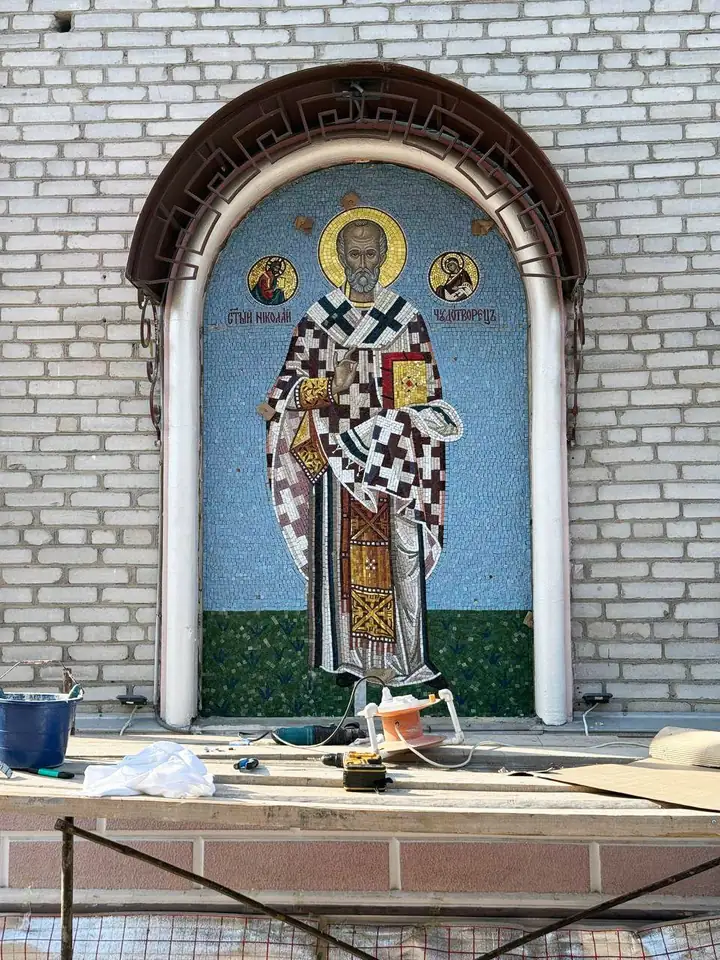
Smalti mosaic icon of St Nicholas for a church facade in Shymkent, Kazakhstan
A client sent us a sketch of an icon of St Nicholas the Wonderworker and asked for it in mosaic, on time and with gold smalti on the halo. We assembled it by the direct method on a wall of our studio, cut it into sections, shipped it to Kazakhstan and installed it on the facade of a church in Shymkent.
Mosaic icon of St Nicholas for a church facade in Ulyanovsk
We made a smalti mosaic icon for the facade of the Church of St Nicholas in Ulyanovsk. It depicts the Miracle of Nicaea and was assembled in our Moscow studio, then installed over the main entrance by crane in about five hours.
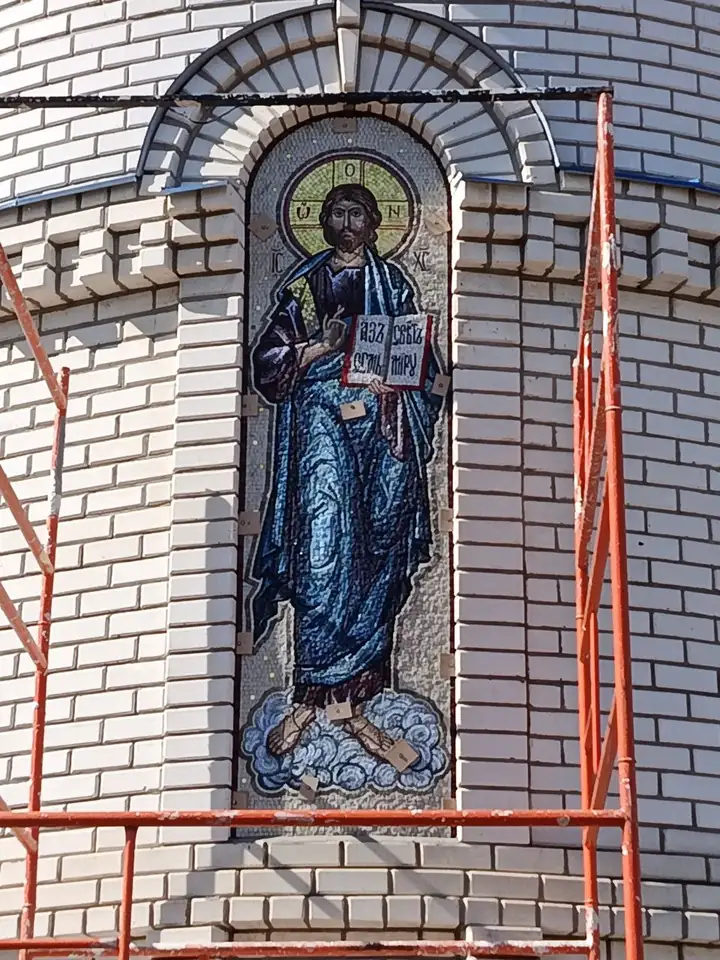
Mosaic icon of Christ the Saviour for the Church of St Nicholas, Ulyanovsk
Our third mosaic icon for the Church of St Nicholas in Ulyanovsk: a full-length Christ the Saviour in our own smalti, designed to match the icons of St Nicholas and St John Climacus we made for the same church.
Like this project?
We will make a mosaic like this for your space: an artist proposes a sketch, a manager calculates the cost and timeline. The consultation is free.