
Golden Hour: a triptych of mosaic portraits in smalti, glass and gold
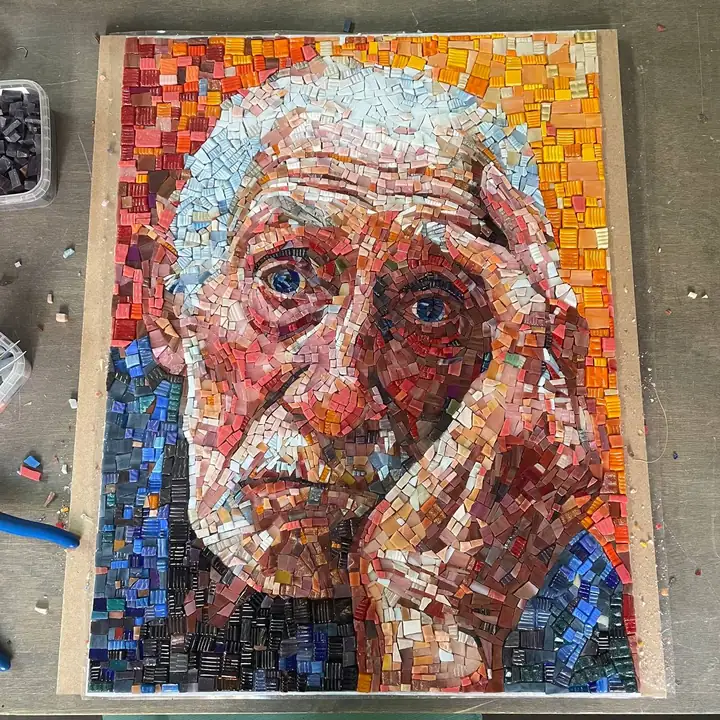
Golden Hour is one of the studio's own creative projects: a triptych of portraits about warm evening light, assembled from ArtWorker smalti, gold, glass mosaic tile and natural stone by the double indirect method.
- Material
- ArtWorker smalti, gold smalti, gold glass mosaic tile, glass mosaic tile, natural stone
- Technique
- Double indirect method with micromosaic details
- Design
- Sketches by Daria Pervushina; idea and project lead Sergey Kolbasov
The idea
With so many commissions on the go, the studio rarely has time for its own creative projects. This triptych was one we could not pass by. Each portrait was made slowly and with great care, so that every viewer could feel what the artist put into it.
The idea and project management came from Sergey Kolbasov; the sketches and lead artwork came from Daria Pervushina. Looking at the sketches, we could see many possible techniques and styles, and in the end we decided not to limit ourselves: the portraits combine many materials and several techniques.
The golden hour is the time shortly after sunrise or before sunset, when daylight looks redder and softer than when the sun is high.
In my work I have always loved to capture light in any way I can: with thick paint and contrasts of dark and light, with the last rays of sunset in a photograph, with bright highlights in vector graphics. Portraits became my favourite, and I always wanted to translate one into mosaic, a material with volume that can achieve any texture. Golden Hour was born from our work together with the ArtWorker studio.
Daria Pervushina, artist
Sketch and materials
As always, the first stage was preparing the sketch. When an image is complex or hard to read, it helps to mark on it the scheme the mosaic will follow. This makes assembly easier and keeps the result as close as possible to a painterly original. The whole assembly was supervised by the author of the sketches.
The triptych combines a wide range of materials to get the most painterly image and a strong contrast of gold. Backgrounds and most of the portraits are in our own smalti. Highlights and clothing are in gold glass mosaic tile and gold smalti. For extra surface texture we added glass mosaic tile and natural stone. Each portrait uses these materials in different proportions, which unites the three works and still gives each its own character.
To cut such different materials we used several wheeled nippers: reinforced Italian nippers, nippers for stained glass, classic Chinese nippers and special nippers for stone.
Double indirect method
All three works were made by the double indirect method, which suits small modules best. It is considered one of the most difficult methods, but if every stage is followed, it runs smoothly.
The prepared sketch is covered with a special adhesive film, and the mosaic is assembled directly on it, face up. This is very convenient for small painterly details of a portrait. Once the mosaic is complete, the areas with the smallest modules are fixed with gelatine, as in micromosaic.
The whole mosaic is then covered with gauze and brushed with the same gelatine mixture. When the gelatine has dried and holds the work, we turn it over carefully, ideally under a board of the same size so the edges are not damaged, and remove the adhesive film. This is done slowly, warming the surface with boiling water or a hairdryer so that the smallest pieces stay in place.
After the film and gelatine residue are removed, we continue with the classic indirect method, coating the back with adhesive. When it has fully set, the work is turned face up again and the gauze and gelatine are removed from the front, again with hot water.
Three portraits, one series
The three portraits are linked by composition as well as by material and technique: a dark background, flecks of gold and highlights of light run through all of them. We framed them in identical frames to underline their unity. Each portrait can stand alone, but together they concentrate the warmth the author put into them.
We worked on the series without hurrying, trying to capture every detail. In places we used micromosaic, elsewhere larger modules, and together they convey the author's love of light. The texture of the material strengthens the meaning of the image and its emotional contrast, and the play of light on the mosaic gives the portraits life.
Project gallery
28 photos — click to enlarge.
How we can make it for you
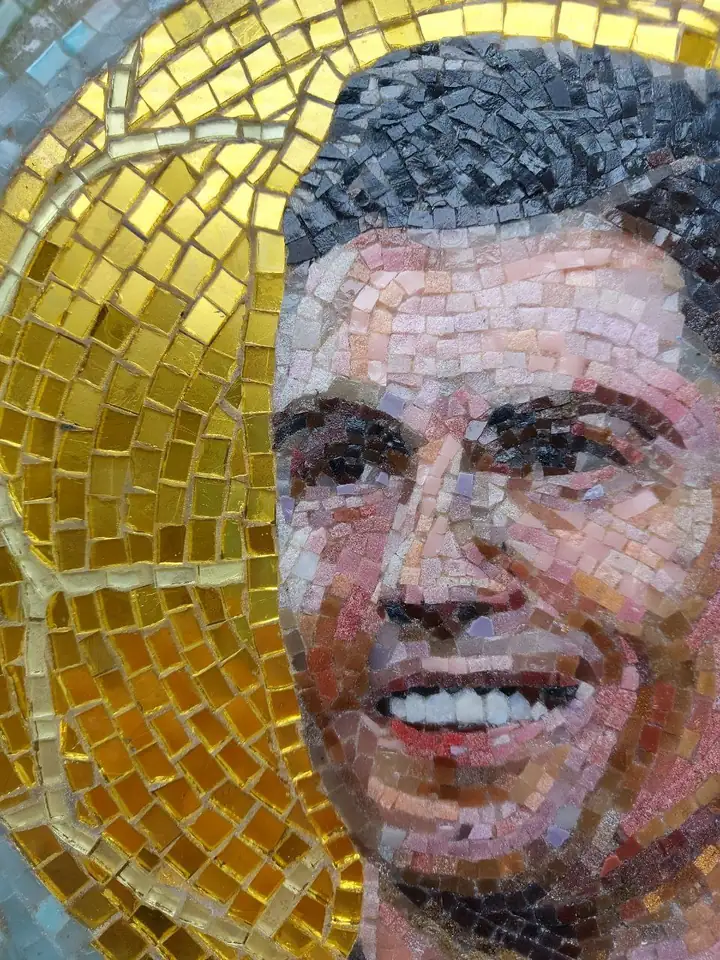
Custom mosaic portraits
We make portraits from your photograph in smalti, glass mosaic tile or natural stone, from a small framed piece to a portrait set directly on the wall.
From $1,590 per portrait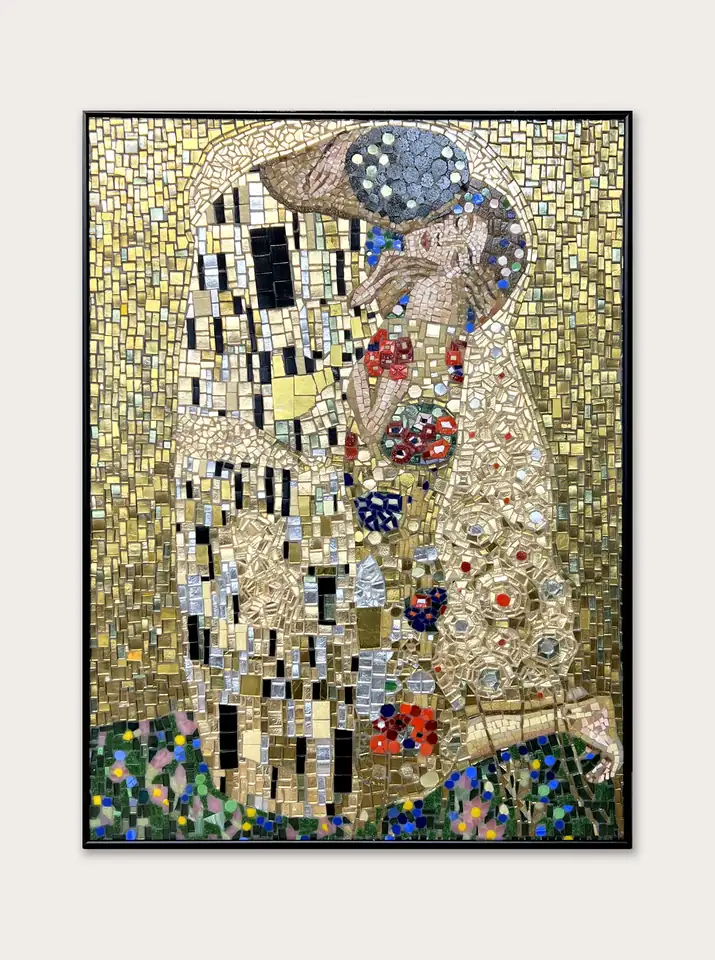
Mosaic artworks to order
We make mosaic artworks in smalti from any image you choose, or design an original sketch to your brief: a colour accent for a home, hotel or office, framed or installed on the wall.
From $900 per m²Similar projects
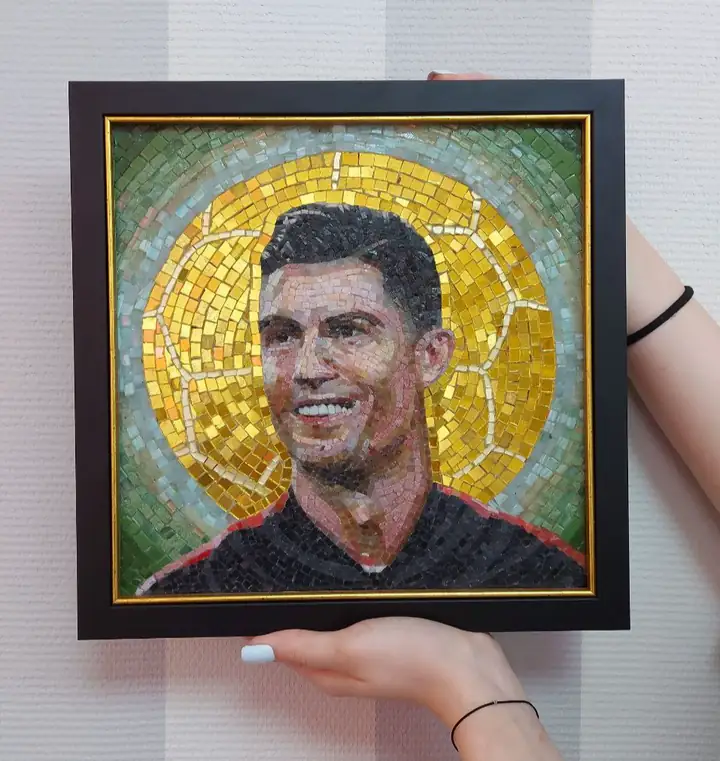
Cristiano Ronaldo portrait in micromosaic with smalti and gold
A photographically precise portrait of Cristiano Ronaldo, set in 1–4 mm modules of smalti, glass mosaic tile and gold in our Moscow studio. The background echoes the Portuguese flag, and a golden ball nods to his victories.
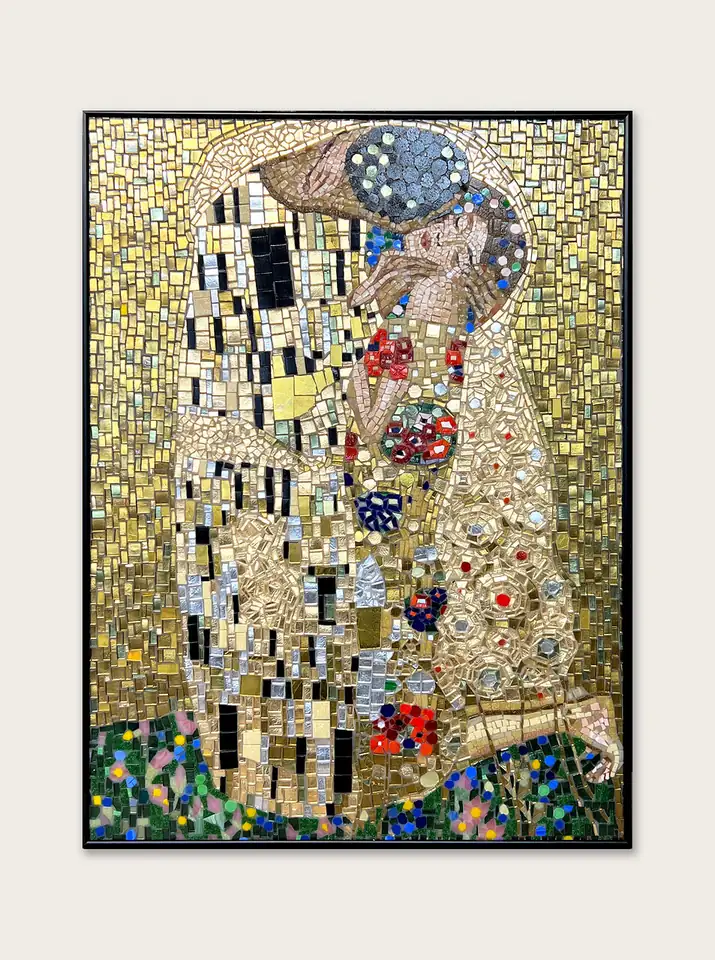
Gustav Klimt's The Kiss in gold, smalti, glass tile and stained glass
LITOKOL commissioned a mosaic after Gustav Klimt's The Kiss to show its epoxy product, used here as both adhesive and grout. We combined smalti, glass mosaic tile and stained glass in one framed panel.
A stained glass mosaic portrait from an AI-generated sketch
An experiment in our Moscow studio: a mosaic portrait whose sketch, and even the choice of material, came from a neural network. We made it in stained glass and glass mosaic tile, following the AI's layout piece by piece.
Like this project?
We will make a mosaic like this for your space: an artist proposes a sketch, a manager calculates the cost and timeline. The consultation is free.