
Restoring the mosaic ring of the Zaisan memorial in Ulaanbaatar, Mongolia
The Zaisan memorial above Ulaanbaatar has a huge ring of tile mosaics on Soviet–Mongolian history. Working with an Irkutsk charity foundation, our team of six spent about two weeks on site consolidating the mosaic and rebuilding its losses.
- Location
- Zaisan memorial, Ulaanbaatar, Mongolia
- Material
- Metlakh ceramic tile
- Technique
- Injection consolidation, removal of later repairs, reintegration of losses, grouting
- Time
- About two weeks on site
- Client
- Close to the Heart charity foundation, Irkutsk
The memorial
The memorial to Soviet soldiers on Zaisan Tolgoi took its present form in 1979, the 40th anniversary of the battles of Khalkhin Gol. It stands on a hill in the north of Ulaanbaatar, framed by mountains, with the International Buddha Park at its foot.
A concrete spire crowned with a hammer, sickle and the Soyombo sign rises beside a figure of a Soviet soldier holding the Victory banner. A stairway leads up to a vast ring lined with mosaic scenes, and from the top there is a view over the city and the Tuul river valley. The scenes tell of Soviet support for the People's Revolution of 1921, the defeat of the Kwantung Army at Khalkhin Gol, the defeat of Nazi Germany, peacetime achievements and Soviet space flights.
The mosaic is made of Metlakh ceramic tile in a bold graphic style. Over the years many areas had decayed, been lost or been replaced with repairs that differed from the original in style and material.
Planning from a distance
The restoration was led by the Irkutsk charity foundation Close to the Heart, which asked us for help because of the scale of the work and the tight deadline. We had to estimate the job from photographs and descriptions, always allowing for surprises that photographs never show.
We put together a team of six and travelled to Ulaanbaatar via Irkutsk together with the foundation's team. On the first day our restoration artist inspected the site and found many small losses, areas of delamination and later repairs, and drew up a list of work: consolidating delamination at the edge by injection, removing later repairs, assembling and setting lost areas on site, local re-adhesion, grouting, cleaning and biocide treatment.
On the scaffolding
We split the team in two: one half prepared materials and fragments on the ground, the other worked on the scaffolding. First we consolidated the critical areas, where the mosaic was coming away from the support and threatening to fall. Adhesive was introduced behind it, partly by injection, and the bond was restored.
Next we removed the later repairs, made from ceramic tile, glazed wall tile and painted cement. On the ground, part of the team assembled the missing fragments from tracings, and these were then set in place. The joints were grouted, which also strengthens the mosaic, and the surface was washed.
Work on site took about two weeks, not counting the missing fragments assembled by the Close to the Heart foundation in its Irkutsk workshop. The mosaic regained its original look and the risk of loss was removed.
It is right that monuments like this are being restored and that people are finally paying attention to their condition. Too many fine works have disappeared through indifference.
Nikita Polyakov, restoration artist, ArtWorker Mosaic Studio
Project gallery
9 photos — click to enlarge.
How we can make it for you
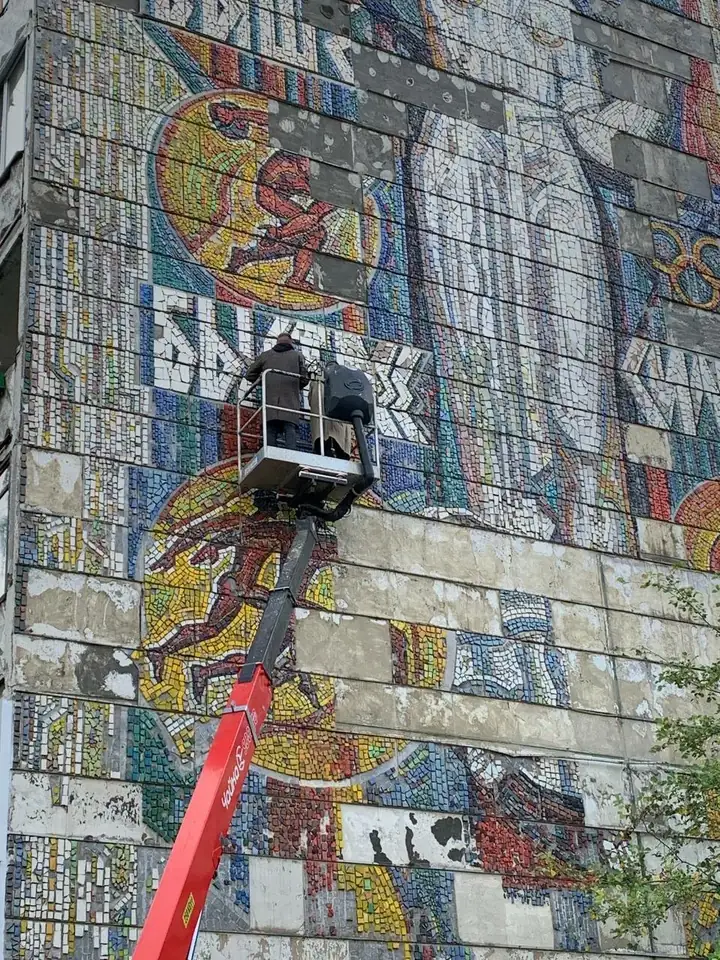
Similar projects
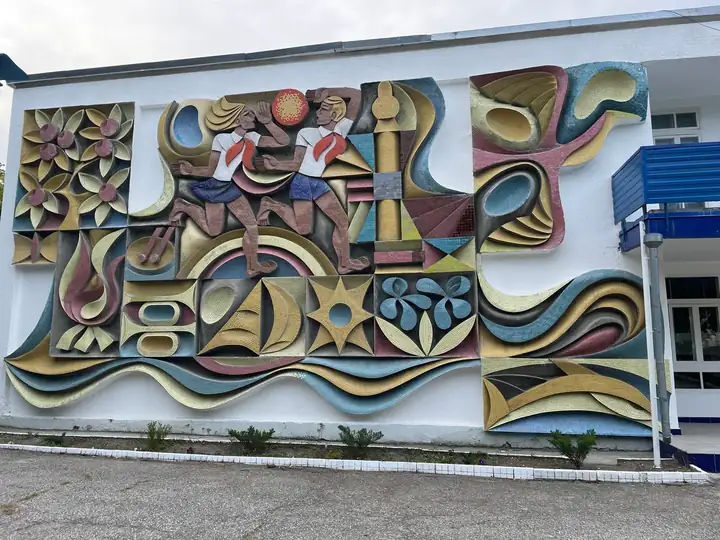
Restoring the 1974 'Childhood' relief mosaic at the Albatros camp, Kabardinka
'Childhood' is a 1974 facade mural by the Poddubsky artist duo at the Albatros children's camp in Kabardinka. Sea air, storms and old repairs had left it in an emergency state; we restored it in 2023 and returned in 2024–2025 for a second campaign.
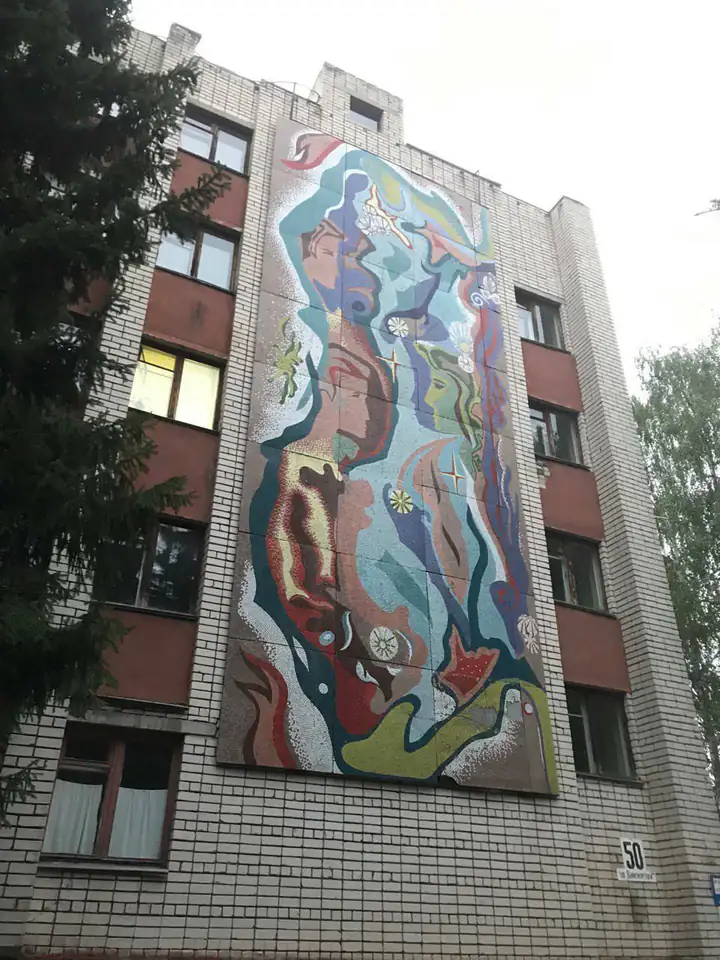
Survey of a damaged 1990 facade mosaic in Novocheboksarsk
In 2023 strong winds tore most of a 1990 ceramic mural off a building in Novocheboksarsk. In December that year we travelled to the site to assess the surviving panels and advise on the next steps.
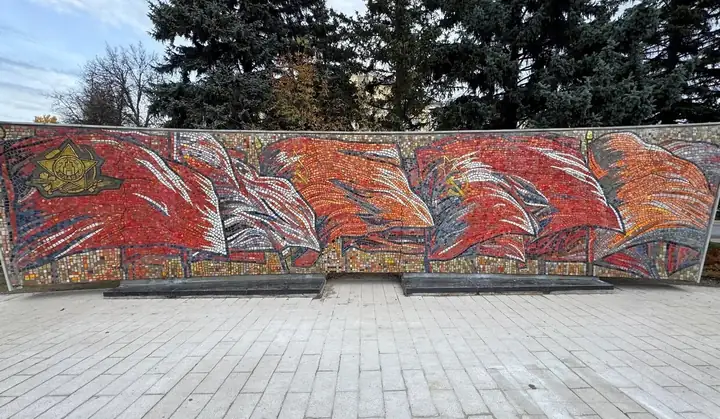
Restoring the 1967 Glory Memorial mosaic of the Sokol aircraft plant
A 1967 smalti mural of red banners honours the workers of the Sokol aircraft plant who died in the Second World War. Commissioned by the Nizhny Novgorod city administration, we took it down, rebuilt it on a new support and returned it to the memorial in 50 days.
Like this project?
We will make a mosaic like this for your space: an artist proposes a sketch, a manager calculates the cost and timeline. The consultation is free.