
Restoring the 1967 Glory Memorial mosaic of the Sokol aircraft plant
A 1967 smalti mural of red banners honours the workers of the Sokol aircraft plant who died in the Second World War. Commissioned by the Nizhny Novgorod city administration, we took it down, rebuilt it on a new support and returned it to the memorial in 50 days.
- Location
- 7 Chaadaeva Street, Nizhny Novgorod, Russia
- Area
- 30 m²
- Material
- Original Soviet smalti and gold smalti; ArtWorker smalti for losses
- Technique
- Detachment, cleaning and transfer to a new support
- Time
- 50 days
- Client
- Nizhny Novgorod city administration
Condition before restoration
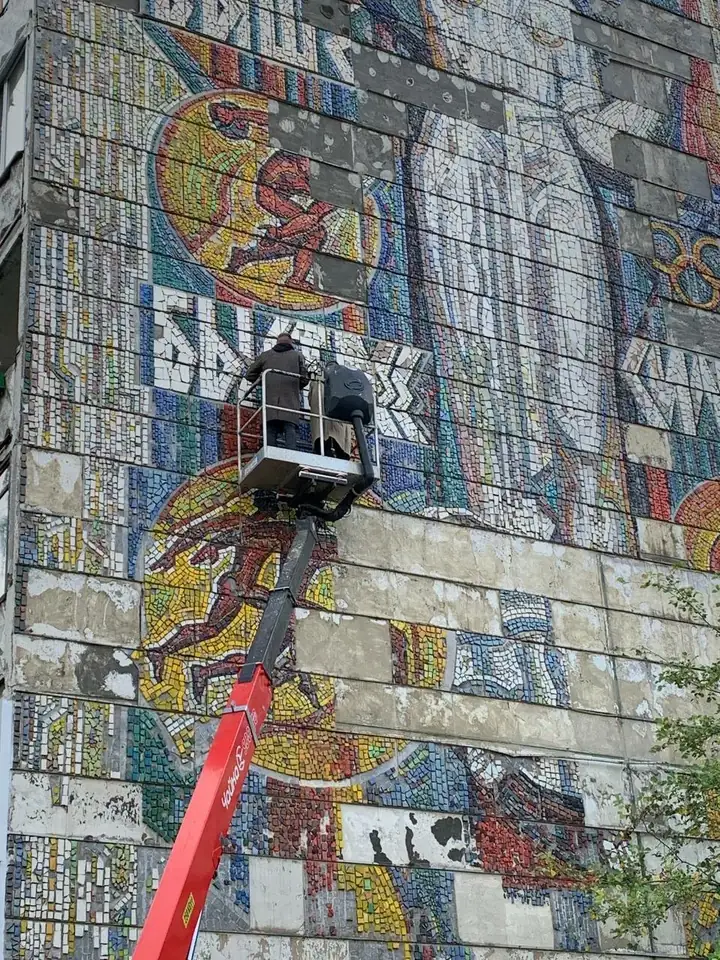
The mural was made in 1967; its author is unknown. In September the city administration asked us to assess the memorial and restore the panel of red banners.
At the survey it was in poor condition. Parts had collapsed, wide cracks ran along the joints, and many tesserae were missing. Earlier repairs had filled the losses with ordinary glass backed with coloured film or simply painted them with acrylic. The surviving smalti was covered with a layer of dirt.
Detachment
The old adhesive bed was badly degraded and could not be saved, so we decided to replace it entirely. That meant taking the mural apart in sections, moving it to our workshop, resetting it on a new support and matching new smalti for the losses as closely as possible. The aim throughout was to keep the artist's design intact.
Cleaning and sorting the tesserae
Every piece was sorted by colour and by damage. During the survey we found two types of smalti in the Soviet mural, sintered and furnace-melted, the same two kinds we make in our own production.
We removed the surface deposits with special solutions and wire brushes and brought back the original colours. Even pieces that looked lost came back to life after careful treatment. For the losses and for tesserae that could not be saved we matched new smalti from our palette so that it sits naturally within the original work.
The original setting was unusual: every tessera was fully embedded in cement-based tile adhesive that filled all the gaps. This made the mosaic strong and weatherproof, but also very heavy.
Reassembly and the Order of Glory
Each section was reassembled on a prepared table. Because the memorial wall is curved, we gave the table a slight curve as well. Our artists used the original smalti wherever possible and added new tesserae only where nothing survived. The large module of the Soviet mosaic helped the work move quickly.
The Order of Glory, First Class, is the one element made in a small module and in gold smalti, which makes it stand out from the rest of the image. It shows a Kremlin tower with its clock, framed by laurel and oak branches, the word 'Glory' in the centre, and a star with hammer and sickle entwined with a St George ribbon, all outlined in black. The old gold had decayed over the years and very little could be reused, so we rebuilt this fragment mostly from new gold smalti and renewed the grey setting bed.
Preparing for installation
The finished mural was too heavy to transport whole, so we cut it into smaller sections. The cut lines were planned so that the joints would be as discreet as possible once reassembled on site. Each section was then reinforced on the back with an extra layer of adhesive and mesh.
Installation
Even after cutting, the sections were large, and lifting and setting each one was hard work for an experienced team. Every section was bedded in cement-based adhesive with an elastic additive and held with temporary safety screws, which were removed once the mortar had cured. The joints between sections were then filled with adhesive.
After three days of installation and finishing, the mural looked as it did when it was new. The project ended with a ceremonial reopening of the memorial, attended by local residents, plant workers and city officials.
Project gallery
31 photos — click to enlarge.
How we can make it for you
Similar projects
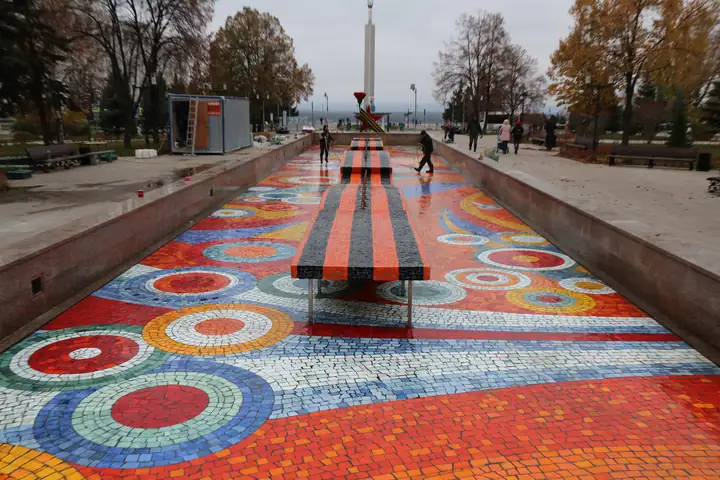
280 m² of new smalti for the 30 Years of Victory fountain in Samara
Restoring the mosaic of the 30 Years of Victory fountain in central Samara is one of the largest projects we have taken part in. In just over four months we developed and melted hundreds of new smalti colours and assembled more than 280 m² of mosaic.
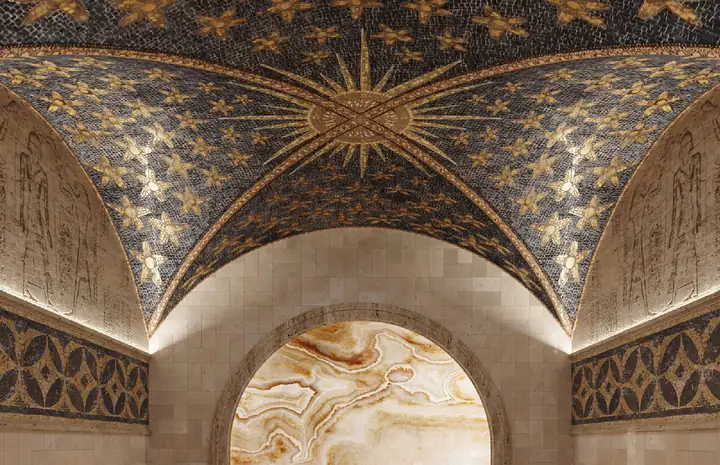
Starry sky: a smalti and gold mosaic ceiling for a hammam
Designer Anastasia Karpova created a hammam interior that recalls a pharaoh's palace. We made its cross-vaulted mosaic ceiling, a deep blue night sky with more than 100 gold stars and a sun at the centre, along with ornamental wall bands.
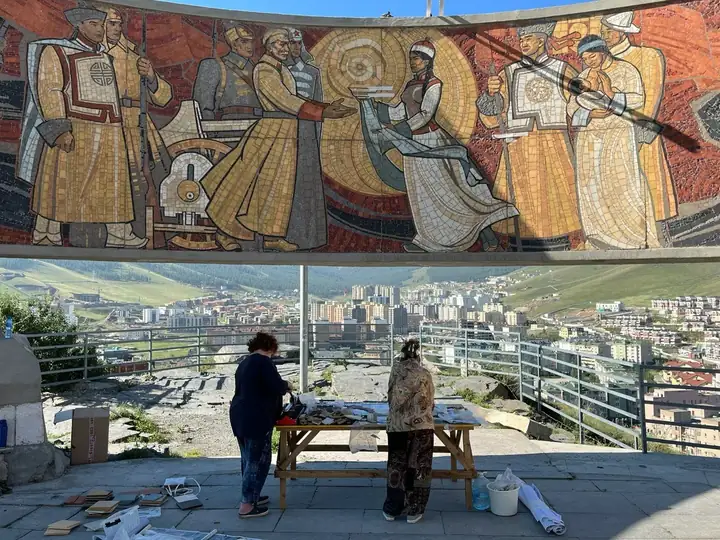
Restoring the mosaic ring of the Zaisan memorial in Ulaanbaatar, Mongolia
The Zaisan memorial above Ulaanbaatar has a huge ring of tile mosaics on Soviet–Mongolian history. Working with an Irkutsk charity foundation, our team of six spent about two weeks on site consolidating the mosaic and rebuilding its losses.
Like this project?
We will make a mosaic like this for your space: an artist proposes a sketch, a manager calculates the cost and timeline. The consultation is free.