
Restoring Vladimir Frolov's mosaic over the entrance of Shekhtel's mansion
Above the main entrance of Fyodor Shekhtel's own house in Moscow is a smalti mosaic made by Vladimir Frolov to the architect's sketches. Six of our specialists spent just over two weeks returning its gold background and irises to full strength.
- Location
- 28 Yermolaevsky Lane, Moscow, Russia
- Area
- 835 × 1540 mm
- Material
- Smalti and gold smalti; ArtWorker smalti for losses
- Technique
- Venetian (direct) setting; damaged areas re-set by the indirect method
- Time
- Just over two weeks
- Design
- Vladimir Frolov, to sketches by Fyodor Shekhtel
Shekhtel's own house
Fyodor Shekhtel (1859–1926) was one of the leading architects of the turn of the 20th century and a major figure of Art Nouveau in Russian and European architecture. His mansion on Yermolaevsky Lane was built in 1896 as his second own house, with the architect Vladimir Adamovich, then his assistant. Shekhtel lived here with his family for about ten years, and Mikhail Vrubel, Isaac Levitan, Savva Morozov and Leonid Sobinov were regular visitors.
The house was a field for experiment. Neo-Gothic corner towers and details sit within an Art Nouveau whole. Shekhtel fitted the building onto an awkward trapezoid plot, made every facade equally worth looking at, and designed from the inside out: interiors first, then the exterior shaped around them. He drew everything himself, from furniture and tableware to chandeliers and door handles. At the centre is an oak staircase lit from above.
The mosaic and its symbols
The main entrance sits in a hexagonal tower, and above the portal is the brightest detail of the facade: an 835 × 1540 mm smalti mosaic made by Vladimir Frolov to Shekhtel's sketches. Frolov combined the Venetian technique of mosaic with the Russian school, and works like this one made him one of the leading mosaic masters in the country.
A gold background gives the panel a festive note, and a dark border turns into a chequered band along the bottom.
- '96' for 1896, the year Shekhtel and his family moved in.
- 'S', the first letter of the architect's surname in Latin script.
- An iris in three stages, bud, open flower and fading bloom, a symbol of the cycle of life. The iris was Shekhtel's favourite flower and appears often in his work.
Condition and survey
By the time of restoration the mosaic was in poor condition: dulled by dust, stained with paint, whitewash and soot, marked by salt efflorescence, with lost and chipped smalti, cracks, areas detached from the base and failing grout joints.
We began with a full survey: photographic recording, measurements of the whole mosaic and smalti samples, so that our production could make matching smalti in colour, tone and texture. We then drew an exact measured sketch and took a cartoon from the mosaic that records not only the outlines but the position of every tessera.
Cleaning
The surface was first cleaned with a caustic soda solution and rinsed with water, then worked over with rubber crumb and soft cloths. Ingrained salts and paint in the pores of the smalti and in the joints were removed with a special compound, nylon brushes and a scalpel, and the residue was taken off with cotton swabs moistened with alcohol.
In my view, cleaning a mosaic surface properly is one of the hardest and most painstaking operations. The coloured smalti was quite porous, and the paint had soaked deep into it. We spent a long time on cleaning so that the mosaic could shine again.
Daria Krylova, mosaic artist, ArtWorker Mosaic Studio
Reintegration of losses and grouting
The most damaged tesserae were carefully cut out without disturbing their neighbours, and the base was cleaned with a chisel, scalpel and wire brushes. Areas that had lost their bond with the base were lifted, cleaned and re-set by the indirect method using the cartoon, then returned to their place. The largest damaged areas were in the gold background, which was close to falling.
The original mortar was hard and cracked. Before re-setting, the base was cleaned of old mortar and dust, its cracks repaired and the surface primed; the mosaic was then set in an adhesive made for this kind of work.
Cracks were treated one by one: we took a graphite rubbing on tracing paper, removed the tesserae along the crack, opened it up, cleaned and washed it and filled it with a special mortar, then reset smalti matched in colour and tone. Tesserae that had to be removed because of chips and cracks, mostly in the gold background with its several shades of gold, were replaced with smalti from our own production.
Finally, all the joints, many of which had failed, were regrouted. The work restored both the artistic and the structural integrity of the mosaic.
Project gallery
26 photos — click to enlarge.
How we can make it for you
Similar projects
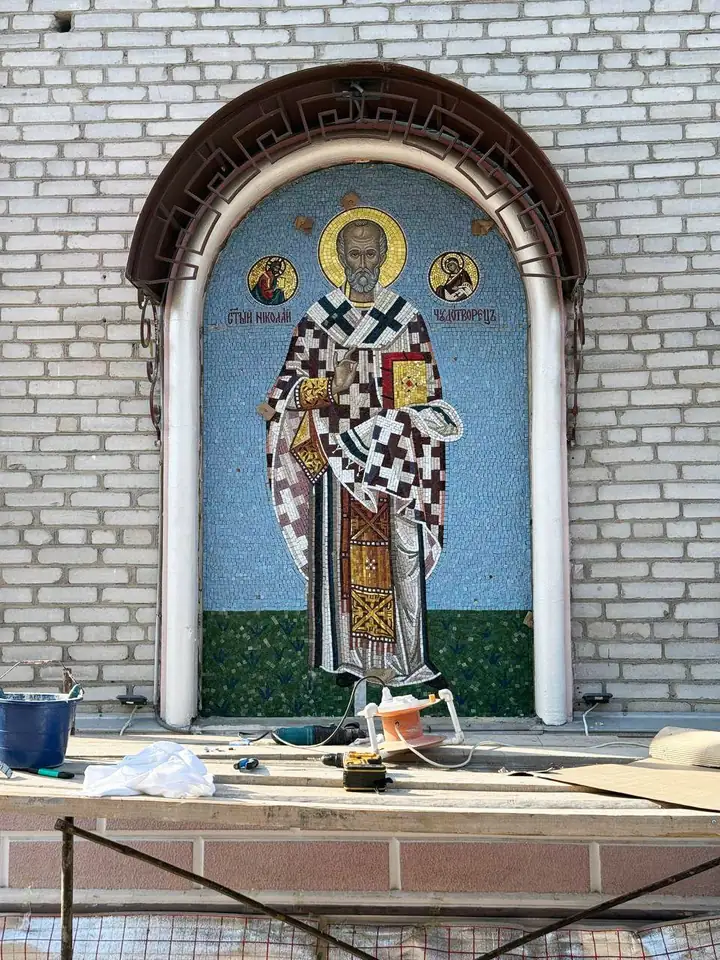
Smalti mosaic icon of St Nicholas for a church facade in Shymkent, Kazakhstan
A client sent us a sketch of an icon of St Nicholas the Wonderworker and asked for it in mosaic, on time and with gold smalti on the halo. We assembled it by the direct method on a wall of our studio, cut it into sections, shipped it to Kazakhstan and installed it on the facade of a church in Shymkent.
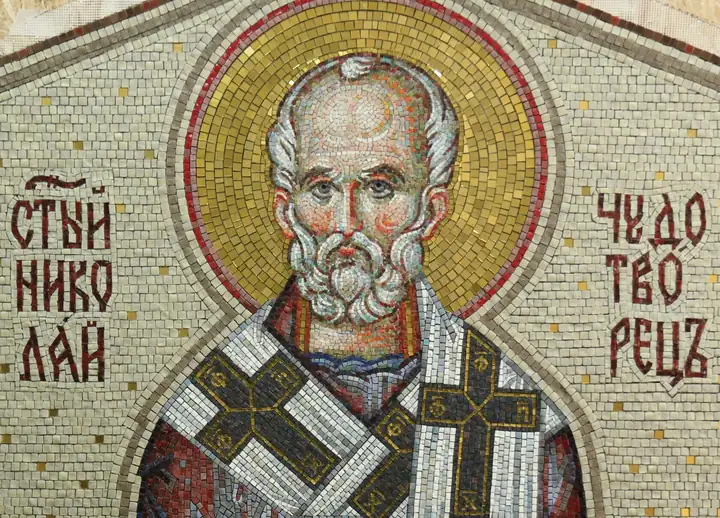
Mosaic icon of St Nicholas for a church facade in Ulyanovsk
We made a smalti mosaic icon for the facade of the Church of St Nicholas in Ulyanovsk. It depicts the Miracle of Nicaea and was assembled in our Moscow studio, then installed over the main entrance by crane in about five hours.
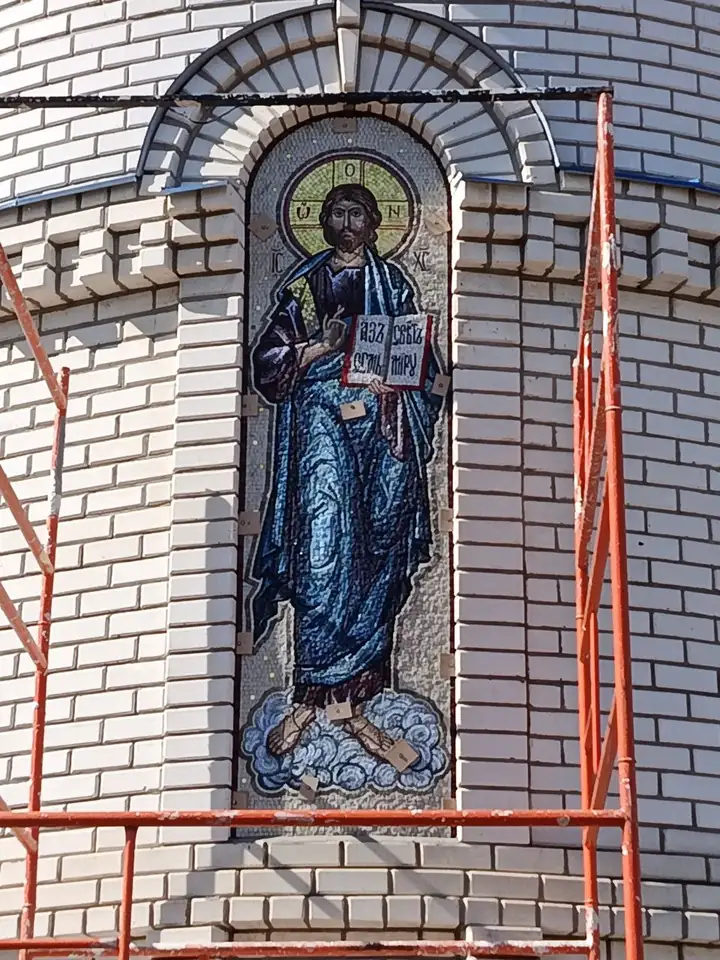
Mosaic icon of Christ the Saviour for the Church of St Nicholas, Ulyanovsk
Our third mosaic icon for the Church of St Nicholas in Ulyanovsk: a full-length Christ the Saviour in our own smalti, designed to match the icons of St Nicholas and St John Climacus we made for the same church.
Like this project?
We will make a mosaic like this for your space: an artist proposes a sketch, a manager calculates the cost and timeline. The consultation is free.