
Restoring the 1974 facade mosaic of the Azot Palace of Culture, Novomoskovsk
In the 2000s the 1974 mosaic on the Azot Palace of Culture in Novomoskovsk was painted over in blue and hidden behind a banner. In summer 2026 we cleaned it back to its original colours, rebuilt the losses and, to a design by artist Vladimir Abikh, set the words 'VSE SLOZHITSYA' ('It will all work out') into areas lost for good.
- Location
- Azot Palace of Culture, Novomoskovsk, Tula region, Russia
- Year
- 2026
- Material
- Smalti and textured decorative render
- Technique
- Consolidation, paint removal, reintegration of losses, toning
- Time
- Summer 2026, with final toning in September
- Design
- Original mosaic 1974; restoration design with lettering by Vladimir Abikh
The mural and what happened to it
Novomoskovsk, in the Tula region, is where the river Don begins and sits on the largest gypsum deposit in Europe. Its economy is built on chemistry, and its key employer is Azot, one of the largest producers of mineral fertilisers in Russia. The facade of the Azot Palace of Culture carries a fine mosaic made in 1974 in a mixed technique: mosaic combined with a rough textured decorative render that restorers call 'shuba', or 'fur coat', for its texture.
Over the years the work wore badly. Many areas of mosaic and render had fallen, others were about to come down. In the 2000s the whole mosaic was painted over with several coats of blue paint and then covered with a banner, so that it effectively disappeared from the townscape. We regularly bring Soviet monumental works back to life, but a mosaic painted over entirely was unusual even for us.
How the project began
In November 2025 the artist Vladimir Abikh contacted us with the idea of restoring the mosaic. We inspected it together, and from the results our restoration artist Nikita Polyakov drew up the restoration programme. Vladimir made the restoration design, placing the words 'VSE SLOZHITSYA' in the areas where the original was lost, in lettering drawn in the style and palette of the mosaic.
The restoration was supported by Andrey Melnichenko's charitable foundation and the Smena festival of monumental art, and work started in summer 2026.
Scaffolding, consolidation and paint removal
Scaffolding went up across the full height of the mural, partly from the roof. Our first task was to consolidate the critical areas, where mosaic or render could fall at once; only then could the facade be worked on in full.
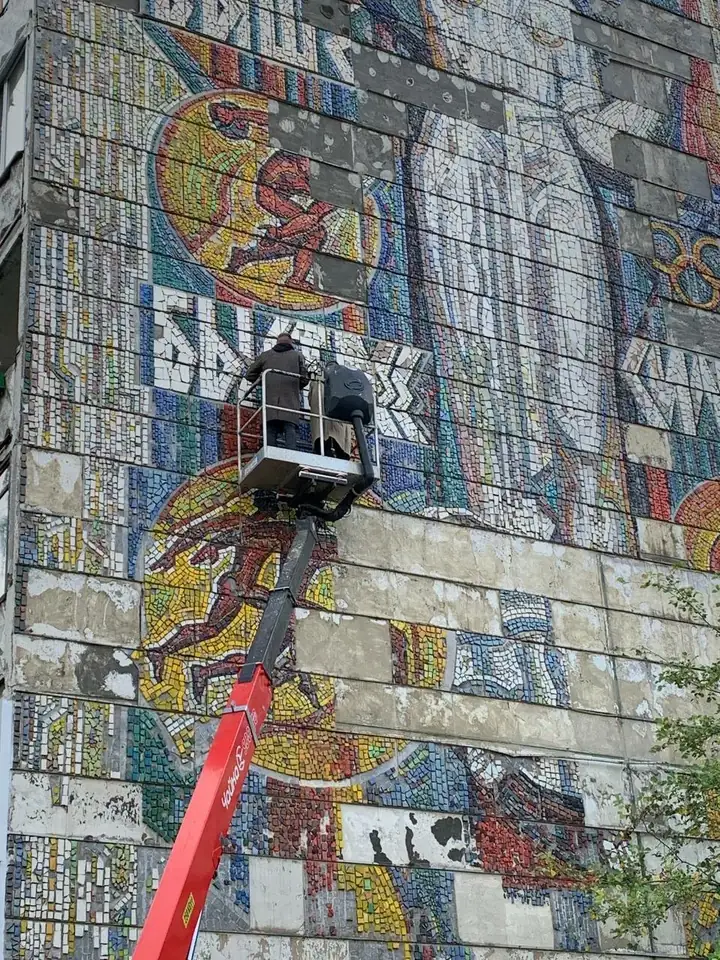
Next came the removal of the paint layers, the most laborious stage. There were several layers, each needing its own solvent, and the paint had worked its way into the pores of the smalti. Centimetre by centimetre, the true colours of the mural came back from under the blue.
Reintegration of losses and the lettering
Alongside the cleaning, we rebuilt the lost elements of the mosaic in the colours of the original smalti and made the 'VSE SLOZHITSYA' lettering. The letters do not compete with the work: they follow its style and palette and sit exactly where the original setting was lost beyond recovery. There were dozens of such losses across the panel.
We also toned the joints and the textured render, rebuilding the lost render texture from scratch and preparing the surface for the letters.
Opening and a second toning
Once the letters were installed, we took down the scaffolding in time for the opening at the end of August 2026. At that point it became clear that the render needed one more coat in milky white to make the work brighter and more expressive. In September we toned it again, this time using rope access, as the scaffolding had already gone.
This work did more than return the mural to display condition and extend its life. It added a new meaning: it will all work out.
Nikita Polyakov, restoration artist, ArtWorker Mosaic Studio
Project gallery
39 photos — click to enlarge.
How we can make it for you
Similar projects
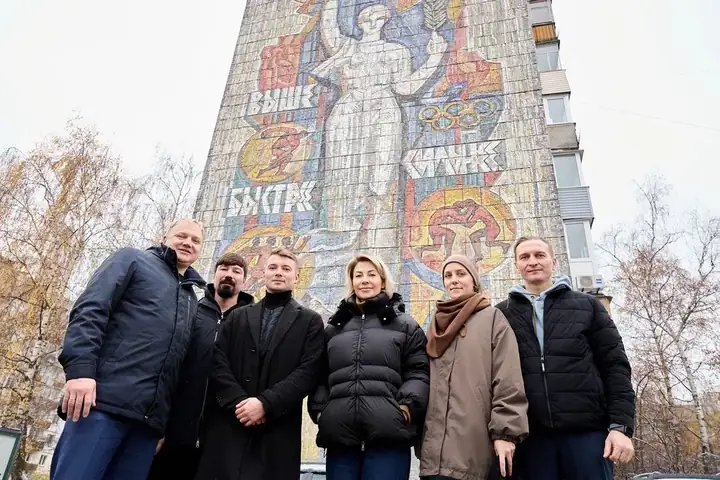
Saving the 1980 'Faster, Higher, Stronger' facade mosaic in Nizhny Novgorod
One of Nizhny Novgorod's largest mosaics, made for the 1980 Olympics, was shedding smalti onto the pavement. Over 2023–2024 we took it down, rebuilt it on new slabs in our workshop and installed it on an insulated facade.
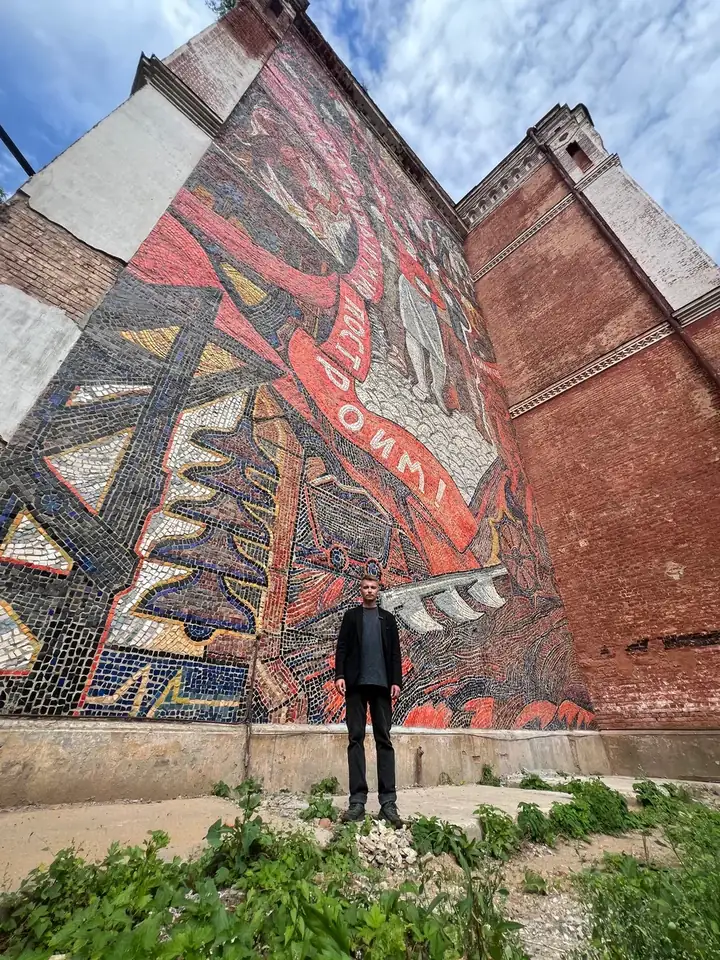
Conservation and restoration of a 1969 mill facade mosaic, Naro-Fominsk
In 1969 Yuri Dekhno's smalti mural 'We Will Build Our New World!' went up on the spinning shop of the Naro-Fominsk mill. When large areas began to come away from the wall, we stabilised it in 2022 and returned in 2024 to rebuild the losses.
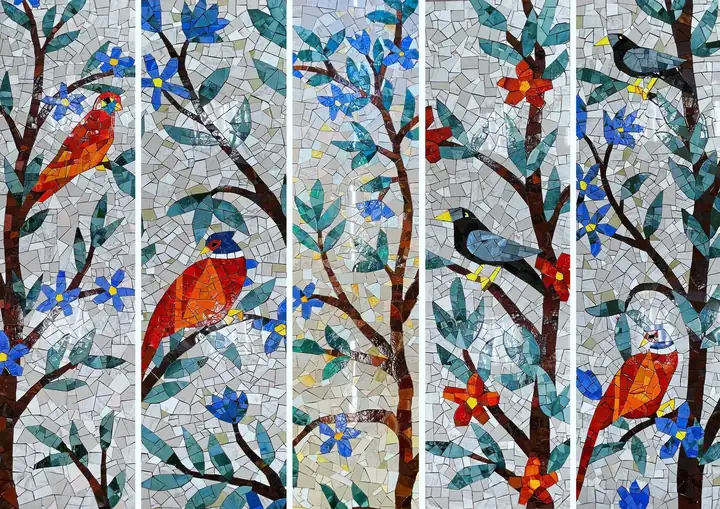
Birds and trees: a series of facade mosaics in smalti and porcelain stoneware
For the facade of a residential building in Kazakhstan we made a series of mosaic panels with birds, trees and flowers: 60 m² in total, with the bright motifs in ArtWorker smalti and the background in porcelain stoneware.
Like this project?
We will make a mosaic like this for your space: an artist proposes a sketch, a manager calculates the cost and timeline. The consultation is free.