
Conservation and restoration of a 1969 mill facade mosaic, Naro-Fominsk
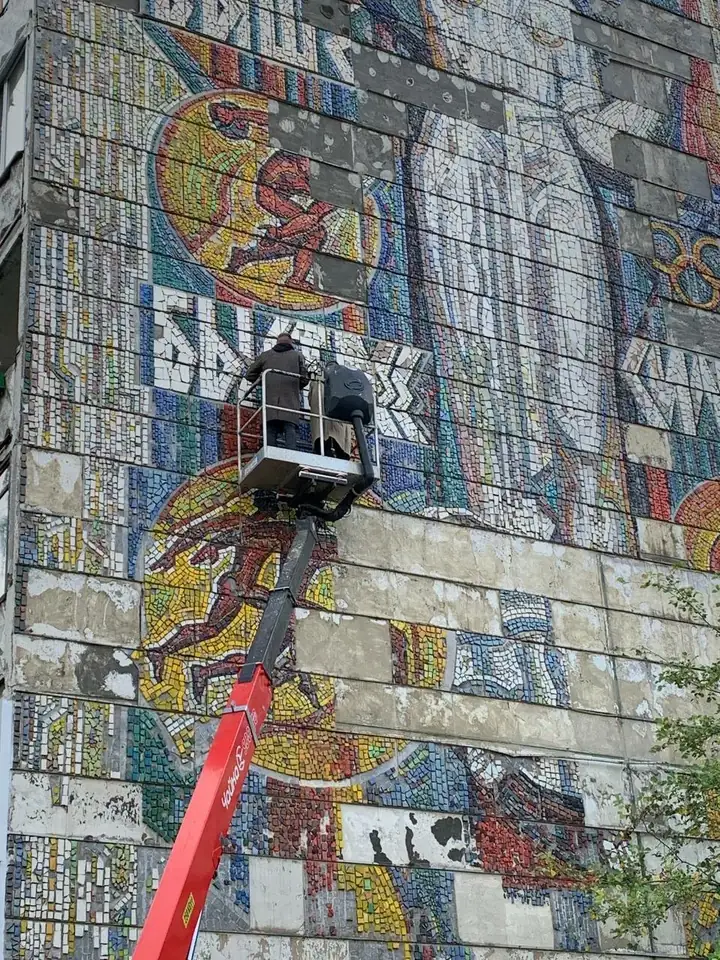
In 1969 Yuri Dekhno's smalti mural 'We Will Build Our New World!' went up on the spinning shop of the Naro-Fominsk mill. When large areas began to come away from the wall, we stabilised it in 2022 and returned in 2024 to rebuild the losses.
- Location
- Naro-Fominsk, Russia
- Year
- 2022; 2024
- Material
- Smalti; ArtWorker smalti for losses
- Technique
- Injection consolidation and anchoring; reconstruction of losses
- Design
- Yuri Dekhno, 1969
The mill and the mural
The spinning and weaving mill in Naro-Fominsk was built in the 1840s and became one of the town's architectural landmarks. Its most important building is the spinning shop, which stands at the centre and is taller and more decorated than the rest. In 1969 its main facade received the mosaic 'We Will Build Our New World!' by Yu. A. Dekhno, in the Socialist Realist style. In expressive colours and lines it shows Lenin and workers alongside revolutionary and industrial scenes, and it shapes the look of the whole main street.
As most of the building fell out of use, the mosaic suffered too and began to separate from the wall. The original installation was also at fault: no reinforcing mesh or equivalent had been used. In places the supporting layer had come completely away from the wall or fallen, with many losses and a risk of whole sheets of mosaic collapsing.
Emergency conservation, 2022
The task was to secure the mural against collapse without taking it down and resetting it on new adhesive. First we had to decide whether conservation on site was possible at all. Visual inspection, investigation and tapping showed that about 35–40% of the area had separated from the wall. The timetable was tight: start at the end of September and finish before the first frosts.
We began with the largest areas of delamination, in the left-centre and lower parts. Some sections had already fallen, but they had been kept by the construction company redeveloping the mill complex.
In the most critical areas we drilled small injection holes and injected adhesive to fill the voids, then secured the treated areas with anchors. As a precaution the same treatment was carried out over the whole mural. We then consolidated loose smalti, cleaned the surface and covered the work with a protective sheet. Further decay had been stopped, and we finished on schedule: on our last day the first snow fell.
Restoration, 2024
In 2024, with the support of the Potanin Foundation and the company Ostov, we started the second stage: reconstructing the losses and returning the mural to display condition.
First we took down the protective sheet, which had covered the mosaic for almost two years and worried local residents. It had been put up to keep the mosaic from shedding tesserae until they could be re-adhered. Underneath there had been almost no losses: the consolidation of 2022 had held, and few areas needed further attention.
We collected smalti samples and sent them to the ArtWorker smalti works, where our colleagues made smalti identical to the original. Meanwhile we treated small losses around the whole mural and carried out preventive consolidation, and our artists drew the lost areas from historic photographs. Some sections that had fallen from the wall in one piece without breaking were reinstated on the prepared wall, so that as much original material as possible was kept.
Reconstruction and grout
When the smalti arrived in Naro-Fominsk, the mosaic artists rebuilt the lost areas and the mural came closer and closer to its original look. The appearance of a mosaic depends not only on the colour and tone of the smalti but on the grout between the tesserae: a darker grout makes the stones look brighter. Grout changes colour as it dries, so we made a series of samples to match the original exactly.
After the reconstruction we washed the whole surface and applied a biocide. The mural is back on public view at the heart of the town.
It is wonderful that there is now interest in preserving works like this, which are part of our history. Many have already been lost for good, but how many more can still be saved!
ArtWorker restoration team
Project gallery
14 photos — click to enlarge.
How we can make it for you
Similar projects
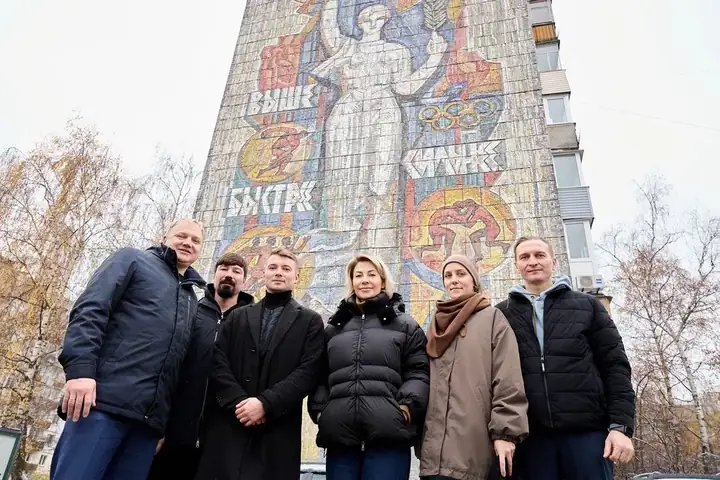
Saving the 1980 'Faster, Higher, Stronger' facade mosaic in Nizhny Novgorod
One of Nizhny Novgorod's largest mosaics, made for the 1980 Olympics, was shedding smalti onto the pavement. Over 2023–2024 we took it down, rebuilt it on new slabs in our workshop and installed it on an insulated facade.
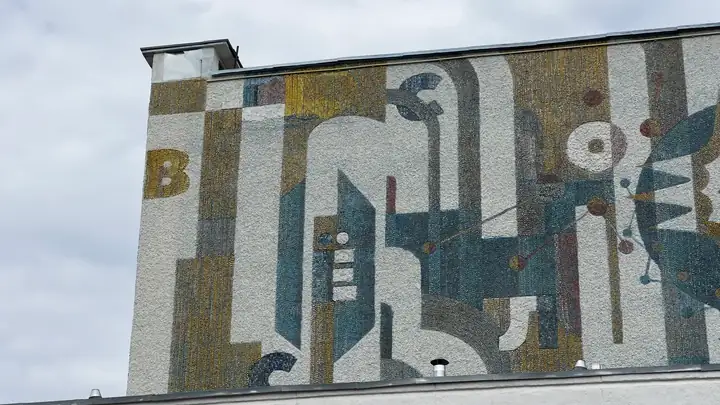
Restoring the 1974 facade mosaic of the Azot Palace of Culture, Novomoskovsk
In the 2000s the 1974 mosaic on the Azot Palace of Culture in Novomoskovsk was painted over in blue and hidden behind a banner. In summer 2026 we cleaned it back to its original colours, rebuilt the losses and, to a design by artist Vladimir Abikh, set the words 'VSE SLOZHITSYA' ('It will all work out') into areas lost for good.
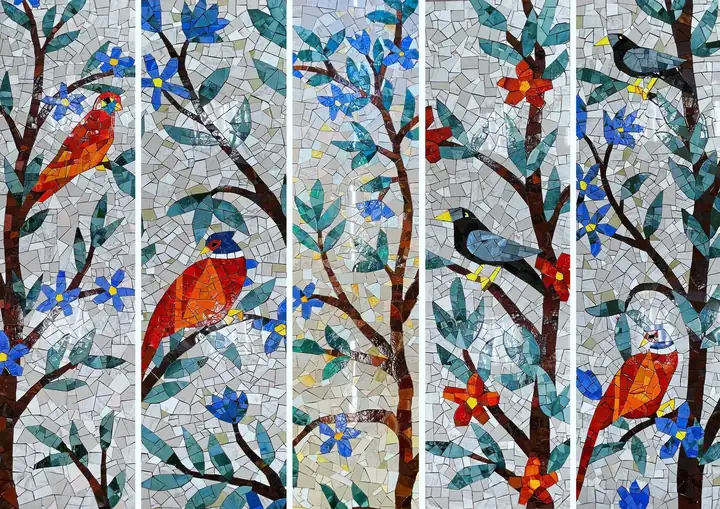
Birds and trees: a series of facade mosaics in smalti and porcelain stoneware
For the facade of a residential building in Kazakhstan we made a series of mosaic panels with birds, trees and flowers: 60 m² in total, with the bright motifs in ArtWorker smalti and the background in porcelain stoneware.
Like this project?
We will make a mosaic like this for your space: an artist proposes a sketch, a manager calculates the cost and timeline. The consultation is free.