
Saving the 1980 'Faster, Higher, Stronger' facade mosaic in Nizhny Novgorod
One of Nizhny Novgorod's largest mosaics, made for the 1980 Olympics, was shedding smalti onto the pavement. Over 2023–2024 we took it down, rebuilt it on new slabs in our workshop and installed it on an insulated facade.
- Location
- 118 Berezovskaya Street, Nizhny Novgorod, Russia
- Year
- 2023–2024
- Material
- Original smalti; ArtWorker smalti made to match
- Technique
- Detachment, transfer to new slabs, reconstruction and reinstallation
- Time
- About three weeks of installation
- Design
- Team of the Gorky art production plant led by V. V. Lyubimov
- Client
- Government of the Nizhny Novgorod region
The mural
On a residential building in the Moskovsky district of Nizhny Novgorod was one of the city's largest mosaics, created by monumental artists of the Gorky creative production plant under V. V. Lyubimov, with A. Shvaikin, B. Kholodenko, A. Rusin and A. Lyubimov. It was made for the 1980 Olympics and shows sporting scenes in a strong, centred composition. The facade faces the nearby Start stadium, tying the whole space together.
The mosaic was set with an experimental polymer-based adhesive. Over the years the bond weakened and smalti began to fall, making it dangerous to walk beneath the wall. The local administration removed the most critical areas, which caused a public outcry. As part of a pilot project to preserve Soviet monumental art, it was decided to restore the work, and the government of the Nizhny Novgorod region invited our team.
Survey and plan
About 35% of the mosaic had already fallen or been removed, and the rest was held only weakly. The slabs carrying the mosaic were also poorly attached: their metal frame had rusted and was missing in places.
Our conclusions: the mosaic had to be transferred to new adhesive; damaged slabs with chips, cracks and losses had to be replaced; the metal frame had to be renewed; and the losses rebuilt from surviving original smalti and new smalti. Historic photographs made it possible to draw cartoons for the missing areas. We split the work into three stages.
Detachment and cataloguing, 2023
In autumn 2023 we photographed the surviving mosaic and gave each slab a number and code so that every piece could be placed exactly. The slabs were removed, packed and taken to storage. This stage had to be finished before the hard frosts, and on the last day of work the first snow fell.
Rebuilding the mural, 2024
Before work could resume we needed a technical design for the installation, working drawings, estimates and a schedule; the restoration itself is only the tip of the iceberg. We also decided to insulate the facade, as residents had complained about the cold wall.
Work started at the end of summer 2024. About 50% of the mosaic was lost. We calculated the missing quantity and made smalti in the ArtWorker smalti works to match the original Soviet material, thanks to our smalti makers and production manager Maxim Mozov.
In a large hangar next to our production we laid out the surviving fragments like a puzzle. The old slabs had decayed and the adhesive had lost its strength, so we made new slabs to the original size with reinforcing mesh. From each surviving slab we took a tracing, detached the tesserae, washed them and reset them on new restoration adhesive following the tracing.
For the missing areas, sketches were drawn from historic photographs, printed at 1:1 and set by a team of mosaic artists led by Daria Krylova. To see the whole work and correct the drawing, we inspected it from a drone.
Installation
Meanwhile the facade in Nizhny Novgorod was cleaned, fitted with guide rails and insulated, work organised by Sergey Kolbasov. When the mural and the facade were both ready, the numbered slabs were shipped from the Ulyanovsk region to Nizhny Novgorod.
We installed the mural from the top down, constantly checking the drawing; installation took about three weeks. The bottom three rows were grouted, as the author had done, probably as protection against vandalism. On our last day the first snow fell, just as it had a year earlier when we finished the detachment. Article by restoration artist Nikita Polyakov.
Project gallery
15 photos — click to enlarge.
How we can make it for you
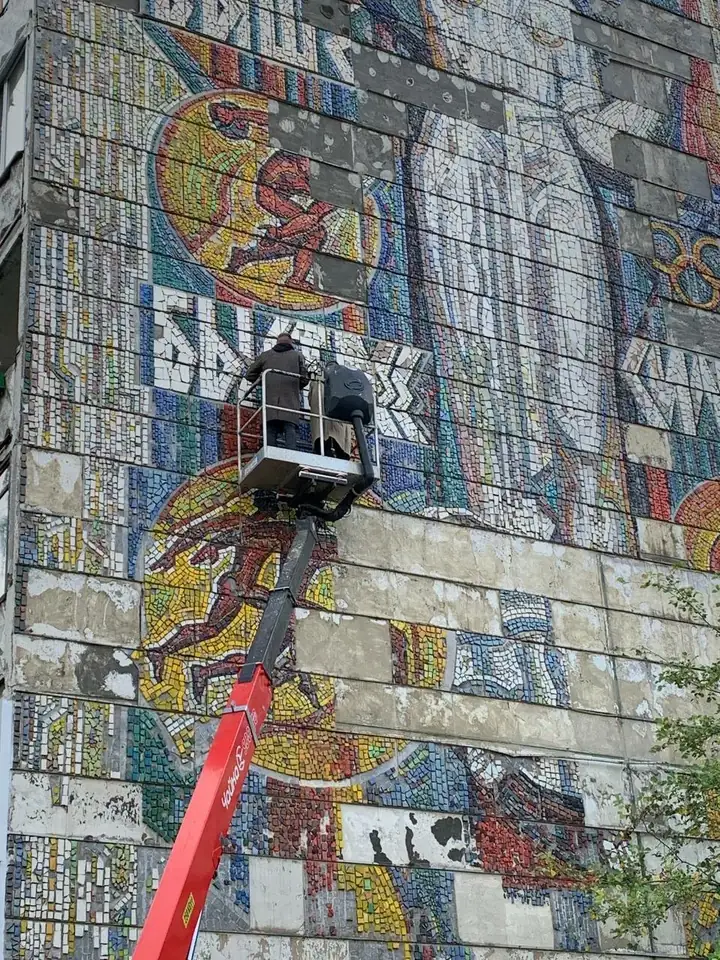
Similar projects
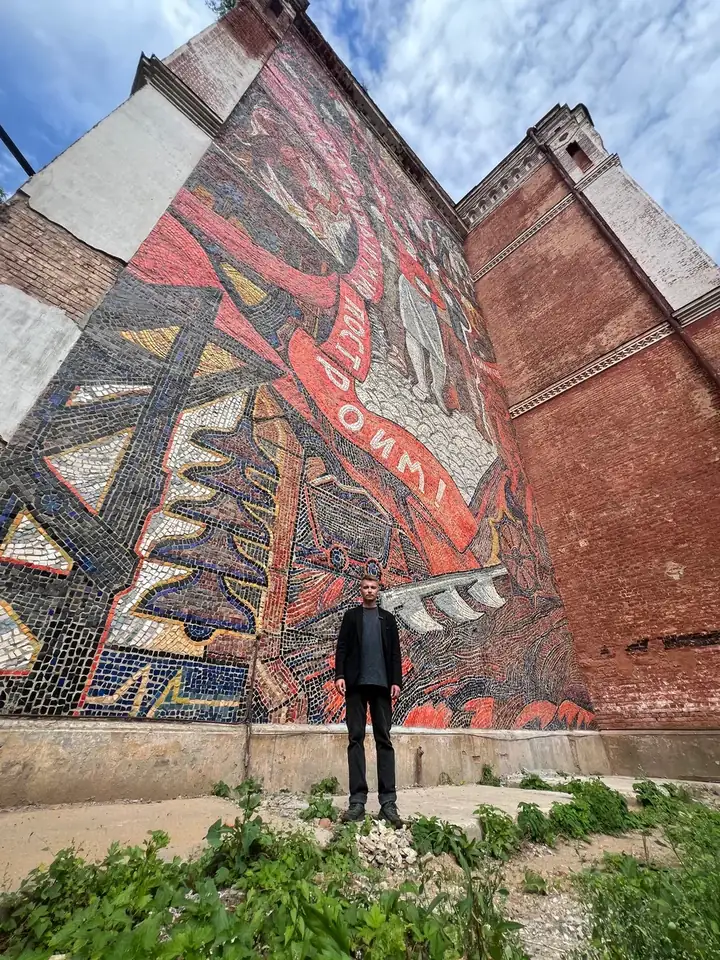
Conservation and restoration of a 1969 mill facade mosaic, Naro-Fominsk
In 1969 Yuri Dekhno's smalti mural 'We Will Build Our New World!' went up on the spinning shop of the Naro-Fominsk mill. When large areas began to come away from the wall, we stabilised it in 2022 and returned in 2024 to rebuild the losses.
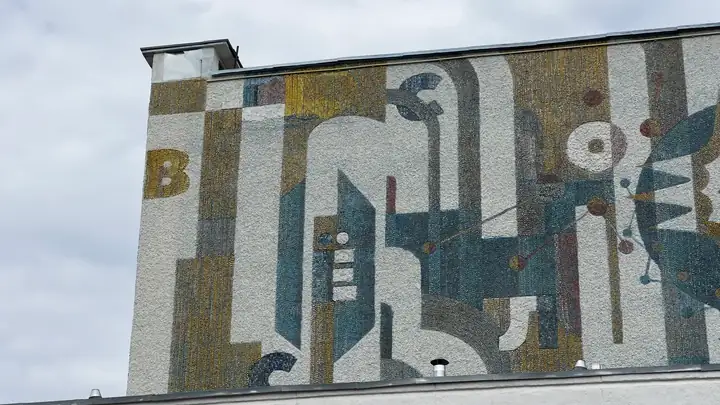
Restoring the 1974 facade mosaic of the Azot Palace of Culture, Novomoskovsk
In the 2000s the 1974 mosaic on the Azot Palace of Culture in Novomoskovsk was painted over in blue and hidden behind a banner. In summer 2026 we cleaned it back to its original colours, rebuilt the losses and, to a design by artist Vladimir Abikh, set the words 'VSE SLOZHITSYA' ('It will all work out') into areas lost for good.
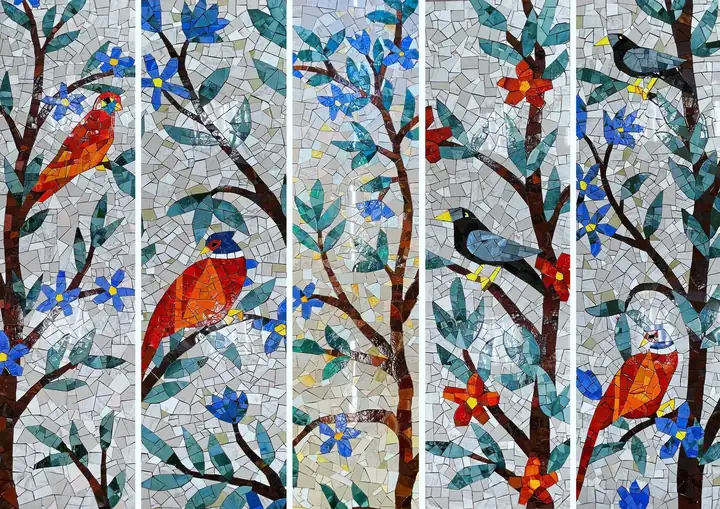
Birds and trees: a series of facade mosaics in smalti and porcelain stoneware
For the facade of a residential building in Kazakhstan we made a series of mosaic panels with birds, trees and flowers: 60 m² in total, with the bright motifs in ArtWorker smalti and the background in porcelain stoneware.
Like this project?
We will make a mosaic like this for your space: an artist proposes a sketch, a manager calculates the cost and timeline. The consultation is free.